
The internet solved one problem in university research: access to information. It did not solve another—finding the right information quickly.
For families considering university abroad, the headline tuition fee is only part of the financial picture. Scholarships may appear on a separate university page. Government grants or loans may sit on another website entirely. External organisations can offer funding that the university itself does not prominently list.
A high school counsellor researching several universities across several countries can therefore spend hours moving between websites simply to answer a basic question: what is this likely to cost this particular student?
That is the problem StudyFundo is designed to address.
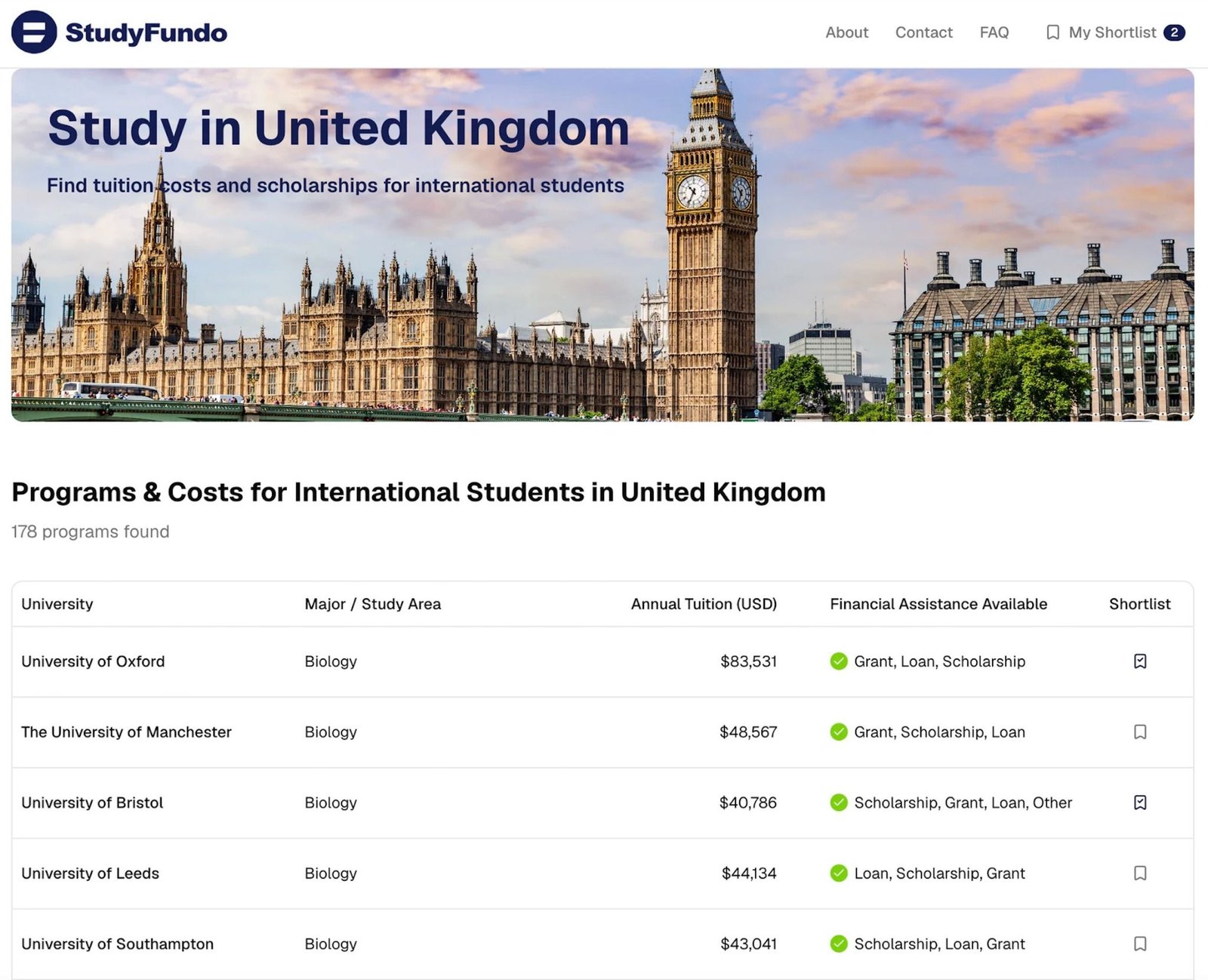
The platform brings university costs and potential sources of financial assistance into a single research process, aimed primarily at high school counsellors and then at parents. Its objective is not to replace detailed research, but to make the first stage far faster.
The problem is fragmentation, not a lack of data
University information is abundant. The difficulty is that it is distributed across different systems, presented in different formats and updated at different times.
Tuition is relatively easy to find. Understanding affordability is harder.
A family may need to investigate university scholarships, government funding, grants, loans, tuition waivers and other forms of assistance before it can judge whether a programme is realistic.
International students face another layer of complexity. Citizenship and residency can influence both tuition rates and eligibility for financial support. Two students applying to the same programme may therefore face very different costs.
StudyFundo incorporates citizenship into the search process alongside field of study and destination, helping make the initial results more relevant to the individual student rather than relying on a generic international price.
Why AI changes the economics of the problem
Until recently, building and maintaining a useful one-stop system for this kind of research would have required a substantial amount of repetitive manual work.
Modern AI-assisted research and data-processing tools make the task considerably more practical.
StudyFundo uses these technologies alongside a structured database built specifically around university costs and financial assistance. Information is checked against source material and reviewed as fees and funding programmes change.
That is different from simply asking a general-purpose AI system to search the open web and produce an answer.
The value lies in combining faster automated processing with information organised around a specific task. In this case, that task is helping counsellors and families identify the likely cost of university and the funding that may reduce it.
Final tuition figures and individual eligibility still need to be confirmed with the relevant university or funding organisation. The technology provides a faster starting point rather than a substitute for verification.
From search results to a working shortlist
The more practical benefit may be what happens after the search. Through StudyFundo’s tools for high school counsellors, relevant programmes can be added quickly to a shortlist and shared with students and parents during a meeting or immediately afterwards.
That shortlist is not merely a record of search results. It becomes a working list of target universities that a family can continue to review and refine.
Programme choices, tuition, deadlines and categories of financial assistance can be kept together, making it easier to track which schools remain serious possibilities as the decision develops.
For a counsellor managing many students, this can reduce both research time and follow-up administration. Rather than spending much of a meeting navigating websites or promising to investigate several questions later—the counsellor can begin comparing options while the student and parents are still in the room.
AI as an efficiency tool, not a replacement for expertise
Much of the discussion around AI in education focuses on whether technology will replace work traditionally done by people. University counselling illustrates a more immediate use: removing repetitive information work so professionals can spend more time on judgement.
Choosing a university involves questions that software cannot settle simply by collecting data. Academic fit, admissions prospects, career ambitions, location and family priorities still require interpretation and discussion.
But finding tuition figures, locating possible funding and organising a list of options are tasks where technology can save considerable time.
That may ultimately be one of AI’s more useful roles: not making the decision, but making the information needed for a good decision easier to find.
For university counsellors and families, that means spending less time searching for the numbers and more time deciding what those numbers mean.
Stay More Update TECHBOOSTED