
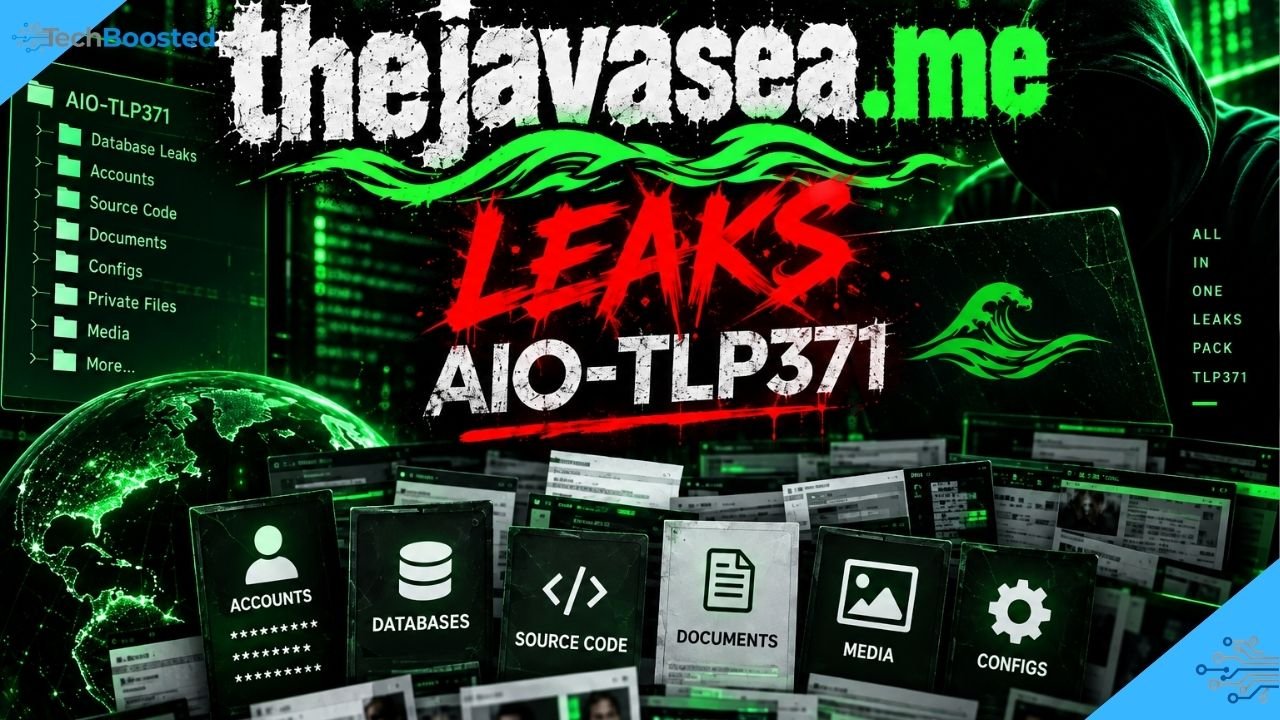
TheJavaSea.me leaks AIO-TLP371 is a search term associated with an alleged online archive or bundled leak identified as “AIO-TLP371.” As of September 2026, there is not enough independently verified evidence to describe AIO-TLP371 as a confirmed new database breach, credential dump, or cybersecurity incident with a known victim, record count, or data source.
The term is real in the sense that it appears across recent web discussions and articles. What remains uncertain is far more important: exactly what AIO-TLP371 contains, where the material originated, whether it is authentic, whether it represents a new leak, and whether descriptions circulating online are accurate. Several recent secondary sources themselves acknowledge those verification gaps.
What Does TheJavaSea.me Leaks AIO-TLP371 Mean?
The phrase combines a domain name, the word “leaks,” and an identifier called AIO-TLP371. Online articles commonly interpret AIO as “all-in-one,” suggesting some type of collection or archive rather than a single file. That interpretation is plausible as informal internet terminology, but no authoritative source documents the naming system behind this particular release.
TLP371 appears to function as a label or identifier. There is no evidence that “371” represents a recognized security classification, a breach severity rating, a number of victims, or an official cybersecurity standard. That distinction matters because some articles have incorrectly connected the letters “TLP” in AIO-TLP371 with the cybersecurity industry’s Traffic Light Protocol.
Is TLP371 an Official Traffic Light Protocol Classification?
No. TLP371 is not an official Traffic Light Protocol designation. The Traffic Light Protocol is a genuine information-sharing standard maintained by the Forum of Incident Response and Security Teams (FIRST). Its current TLP 2.0 specification recognizes exactly four primary labels and no numbered variants exist anywhere in the official standard.
FIRST has confirmed that only labels explicitly listed in its specification are considered valid. There is no TLP371, TLP370, or any similar numbered classification. The “TLP” characters inside AIO-TLP371 could therefore be part of an informal naming convention with no connection whatsoever to the industry framework. Without documentation from whoever created the label, its precise meaning cannot be established.
Is AIO-TLP371 a Confirmed Data Breach?
There is currently insufficient reliable evidence to call AIO-TLP371 a confirmed conventional data breach. A verified breach normally leaves a clear trail: an affected organization issues a disclosure, regulators are notified, law enforcement releases a statement, or established breach-monitoring platforms add the incident to public directories. None of these standard markers have appeared in relation to AIO-TLP371.
Searches of official sources including CISA and major cybersecurity bodies have not produced any corresponding incident report. Have I Been Pwned also does not list AIO-TLP371 as a named breach. This does not prove that no files exist under that name it simply means the evidence presently available does not justify turning claims into established facts.
What Claims About AIO-TLP371 Remain Unverified?
Nearly every specific detail about AIO-TLP371’s contents remains unsupported by independent technical evidence. Some pages describe it as containing personal information or credentials, while others speak generally of large archives, but no trustworthy forensic report has established exactly what information is included. Claims that it definitely contains passwords, banking records, corporate files, or identity documents should not be repeated as fact without verification.
Beyond contents, basic facts remain unconfirmed: there is no verified victim count, no independently established file size, no confirmed source of the material, and no clear timeline for when the data was obtained. It is also unclear whether the material represents newly exposed information or a repackaging of older data from previously known incidents a practice that frequently gives old leaks the appearance of a fresh event.
What Is Known About TheJavaSea.me?
TheJavaSea.me is the domain most closely associated with the AIO-TLP371 label in search results and has been linked to several similar numbered “AIO” releases. Domain records show it was registered in March 2022 and currently uses privacy-protected registrant information a common practice that does not indicate wrongdoing but does limit what can be publicly confirmed about ownership. Technical records including active DNS entries and TLS certificates show ongoing infrastructure activity extending into 2027.
Public information about who runs the site, its revenue model, or direct responsibility for specific leak releases remains scarce. Association in search results is not the same as confirmed authorship or hosting. It is also possible that third parties have used the domain’s name to label material distributed elsewhere, making it difficult to draw definitive conclusions about what the site itself actually hosts or publishes.
Why Search Results Can Make AIO-TLP371 Look More Confirmed Than It Is
A major factor is circular reporting: one site publishes a claim, a second summarizes it without independent verification, and a third cites the second, creating an impression of broad consensus even when all accounts trace back to the same unconfirmed source. Search results can falsely appear to show multiple investigators validating the information, when in reality there is little or no original reporting across the entire list.
Credible reporting should be able to answer: which organization was breached, when access occurred, who independently analyzed the material, what type of information was exposed, how many individuals were affected, whether the data was new or recycled, and whether the responsible party has acknowledged the incident. For AIO-TLP371, none of these foundational answers are presently available from authoritative public evidence.
Does an HTTPS Certificate Mean TheJavaSea.me Is Safe?
No. HTTPS alone does not prove that a website or its downloads are trustworthy. HTTPS encrypts traffic between browser and server, helping prevent casual interception or modification, but it does not certify the legality, reliability, accuracy, or safety of the site’s content. A malicious website can also obtain a fully valid TLS certificate with relative ease.
This distinction matters because automated reputation tools sometimes give positive weight to domain age or HTTPS status. Those are useful technical signals, but they are not substitutes for analyzing the actual files, operators, behavior, and purpose of a site. A padlock icon does not mean the content has been vetted or is safe to download.
Why Downloading an Unverified Leak Archive Is Risky
Even out of simple curiosity, downloading these packages creates risks unrelated to whether the original claims are true. Archives from unofficial sources frequently contain malware, password stealers, keyloggers, and remote-access tools designed to compromise devices. Attackers actively exploit curiosity about high-profile leaks, knowing people may disable security protections or overlook warnings to obtain the material.
Beyond malicious software, seeking these archives exposes users to credential-harvesting pages, deceptive download portals, and phishing schemes masquerading as trusted sources. There may also be legal and ethical considerations depending on jurisdiction and the nature of the material, as data obtained without authorization may be protected by privacy laws. Importantly, there is no practical need to obtain the archive to check whether your own credentials have previously appeared in a known breach.
How to Check Whether Your Own Information Was Exposed
Use reputable breach-notification services such as Have I Been Pwned rather than searching through leaked files yourself. These platforms aggregate confirmed breaches and let you search an email address without downloading or accessing any suspicious material. The directory also explains what types of information were exposed in documented incidents.
A negative result does not guarantee an account has never been compromised no database contains every exposure but it is far safer and more informative than seeking unverified archives. If a service you use publicly announces a breach, rely first on that organization’s official notifications and guidance rather than third-party summaries or leaked lists.
What to Do If You Think Your Credentials May Have Leaked
You do not need confirmation that AIO-TLP371 contains your information to improve account security. Start by replacing reused passwords with unique credentials for every important account, prioritizing your email since control of email typically enables resets across every linked service. The FTC specifically advises against password reuse and recommends updating compromised credentials promptly.
Enable multi-factor authentication wherever available, preferring authenticator apps, passkeys, or hardware keys over SMS where possible. Regularly review active sessions and connected applications, removing anything unrecognized. Be alert to communications that appear unusually credible because they include personal details genuine exposure does not mean a message claiming to help is legitimate. For highly sensitive concerns, resources such as IdentityTheft.gov provide structured guidance.
What Organizations Should Do If AIO-TLP371 Mentions Their Data
Organizations finding themselves mentioned should neither accept unverified claims as fact nor dismiss them without investigation. The recommended approach involves evidence-based incident handling: securing systems, preserving forensic evidence, determining what information could be at risk, evaluating notification obligations, and avoiding misleading public statements. Unknown files should not be casually opened on standard business equipment.
Internal indicators including unusual login patterns, system alerts, or user reports should be taken seriously and evaluated alongside external claims. Working with qualified cybersecurity professionals or incident-response teams ensures that any response is measured, appropriate, and based on verifiable evidence rather than online speculation.
AIO-TLP371: Verified Facts vs Unconfirmed Claims
| Statement | Current Assessment |
|---|---|
| The phrase “thejavasea.me leaks AIO-TLP371” exists online | Verified |
| Multiple websites discuss AIO-TLP371 | Verified |
| “AIO” is commonly interpreted online as “all-in-one” | Common interpretation, not officially confirmed |
| TLP371 is an official Traffic Light Protocol classification | False |
| FIRST recognizes a numbered TLP371 category | False |
| AIO-TLP371 is a confirmed new corporate breach | Not independently verified |
| A specific organization is confirmed as the victim | Not established |
| A verified number of people were affected | Not established |
| The alleged material definitely contains passwords | Not independently established |
| A release label proves a new cyberattack occurred | No |
| Downloading unknown leak files is necessary to check exposure | No |
The clearest assessment as of September 2026 is that AIO-TLP371 should be treated as an unverified leak or archive label, not as a fully documented cybersecurity incident.
Frequently Asked Questions
What is TheJavaSea.me leaks AIO-TLP371?
It is a search phrase linked to an alleged online collection identified by the label AIO-TLP371. While the term appears across many websites, reliable public evidence has not yet established its exact contents, origin, size, or whether it represents a genuine data breach.
Is AIO-TLP371 a real data breach?
It has not been independently established as a confirmed incident with a named victim organization and documented timeline. Files may circulate under this name, but the existence of a label is different from proof that a specific cyberattack occurred.
Does TLP371 relate to the official Traffic Light Protocol?
No. The official standard maintained by FIRST includes only TLP:RED, TLP:AMBER, TLP:GREEN, and TLP:CLEAR. TLP371 is not a recognized designation.
Is it safe to download AIO-TLP371?
No. Archives from unverified sources may contain malware, credential thieves, or deceptive content. They may also include material distributed without authorization, creating privacy and legal risks.
How can I check if my email was exposed?
Use reputable services such as Have I Been Pwned. Follow official notifications from services you use and update passwords whenever there is any concern, enabling multi-factor authentication.
Read More: TECHBOOSTED