
Table of Contents
The graphics card market continues to evolve rapidly, and one of the most anticipated upcoming GPUs is the NVIDIA RTX 5050. Gamers and PC enthusiasts constantly look for powerful yet affordable graphics cards that deliver smooth performance in modern titles. The RTX 5050 is expected to target entry-level and mid-range gamers who want reliable performance for modern gaming without spending on high-end GPUs. As newer game engines become more demanding, budget GPUs must include advanced technologies like AI upscaling and efficient ray tracing to remain competitive. This is where the RTX 5050 could make a major impact in the gaming community.
Another major reason for the excitement surrounding the RTX 5050 is its expected support for modern technologies such as DLSS and improved ray tracing capabilities. These technologies allow gamers to experience better visual quality without sacrificing frame rates. As gaming resolutions increase and developers create more complex worlds, technologies like DLSS help maintain smooth performance even on lower-tier hardware. With the RTX 5050 expected to bring next-generation architecture improvements, many gamers hope it will become the ideal graphics card for budget gaming builds and competitive esports systems.
Overview of the NVIDIA RTX 5050
The NVIDIA RTX 5050 is expected to be part of the next wave of graphics cards designed to provide strong performance at an accessible price point. Traditionally, the 50-series GPUs in NVIDIA’s lineup aim to serve gamers who prioritize efficiency, affordability, and modern gaming features. While flagship GPUs dominate headlines, entry-level cards often play a more significant role in the broader gaming ecosystem. The RTX 5050 may continue this tradition by offering a balanced combination of performance and power efficiency, making it ideal for gamers who build compact or budget-friendly gaming PCs.
NVIDIA has consistently improved performance with each generation of graphics cards, and the RTX 5050 is expected to follow that pattern. By introducing newer architecture and AI-driven features, the GPU could provide smoother gameplay and improved graphics rendering compared to previous entry-level models. Gamers who play competitive titles like battle royale shooters or multiplayer games often value stable frame rates more than ultra-high graphics settings. The RTX 5050 could meet these needs by offering optimized performance that supports modern gaming technologies while maintaining affordability for mainstream players.
Expected Specifications of the NVIDIA RTX 5050
Although official specifications have not yet been fully confirmed, industry leaks and analyst predictions offer insight into what the NVIDIA RTX 5050 might deliver. The GPU is expected to include improved CUDA cores, faster memory bandwidth, and more efficient power management compared to earlier entry-level models. These improvements may allow the RTX 5050 to handle modern game engines more effectively. Memory capacity could range between 8GB and 12GB of VRAM, which would provide enough headroom for modern titles running at high settings in 1080p resolution.
In addition to memory improvements, the RTX 5050 may include updated AI cores dedicated to machine learning tasks like DLSS. These cores allow the GPU to upscale lower resolution images using artificial intelligence, producing visuals that appear nearly identical to native resolution rendering. By combining improved CUDA cores with AI acceleration, the RTX 5050 could deliver a strong balance between graphical quality and frame rate stability. If these rumored specifications prove accurate, the GPU could become one of the most competitive options for gamers who want modern features without investing in premium hardware.
Gaming Performance at 1080p and 1440p
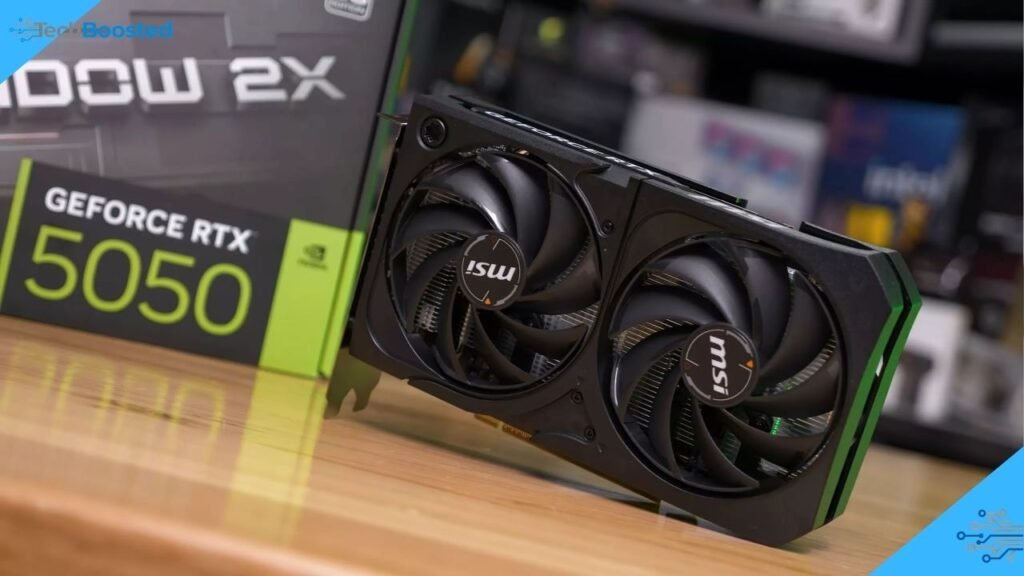
Gaming performance is the most important factor for any graphics card, and the NVIDIA RTX 5050 is expected to perform well in mainstream gaming scenarios. Most entry-level GPUs focus on delivering excellent performance at 1080p resolution, which remains the most widely used resolution among gamers worldwide. The RTX 5050 could provide stable frame rates in popular multiplayer games, including esports titles and competitive shooters. Smooth performance in these games often requires consistent frame rates rather than extreme graphical fidelity.
At 1440p resolution, performance expectations may vary depending on the game’s graphical complexity. While ultra settings might push the GPU to its limits, medium or high settings combined with technologies like DLSS could deliver playable frame rates. Many gamers prefer this balance because it provides better visual quality without sacrificing performance. If the RTX 5050 performs similarly to previous mid-tier GPUs, it could become a popular choice for players upgrading from older hardware that struggles with modern gaming demands.
Ray Tracing Capabilities of the RTX 5050
Ray tracing has become a defining feature of modern graphics cards, allowing games to render realistic lighting, reflections, and shadows. The NVIDIA RTX 5050 is expected to include dedicated ray tracing cores that improve real-time lighting calculations. Although entry-level GPUs typically offer lower ray tracing performance compared to flagship models, the RTX 5050 may still provide a noticeable improvement over earlier generation cards.
With the help of AI upscaling technologies like DLSS, gamers could enable ray tracing without severely impacting performance. DLSS works by rendering games at lower resolutions and then using artificial intelligence to upscale the final image. This method allows GPUs to maintain higher frame rates while still displaying advanced lighting effects. If the RTX 5050 combines efficient ray tracing hardware with improved DLSS performance, it could make advanced graphics features accessible to a much larger audience of gamers.
DLSS Technology and AI Upscaling Features
One of the most exciting features expected in the NVIDIA RTX 5050 is support for DLSS. DLSS stands for Deep Learning Super Sampling and uses artificial intelligence to enhance gaming performance without sacrificing image quality. Instead of rendering every frame at full resolution, the GPU renders a lower resolution image and then uses AI algorithms to upscale it. The result is a smoother gaming experience with higher frame rates.
Newer versions of DLSS have significantly improved visual fidelity, making it difficult for players to distinguish between upscaled and native images. This advancement is particularly important for entry-level GPUs like the RTX 5050 because it allows them to handle demanding games more efficiently. By leveraging AI acceleration hardware, the GPU can maintain stable frame rates even in graphically intensive environments. For gamers who want modern visuals without expensive hardware, DLSS support could be one of the most valuable features included in the RTX 5050.
Architecture and Next-Generation GPU Improvements
The NVIDIA RTX 5050 will likely benefit from improvements introduced in NVIDIA’s newer GPU architectures. Each generation typically brings efficiency improvements, higher transistor density, and smarter AI acceleration capabilities. These architectural upgrades allow GPUs to process complex graphics calculations faster while consuming less power. The RTX 5050 may also include enhanced tensor cores that support advanced AI tasks such as DLSS image reconstruction and frame generation.
Architecture improvements often influence more than just raw gaming performance. They also impact system stability, driver optimization, and future software compatibility. Game developers increasingly design engines around modern GPU capabilities like ray tracing and AI rendering techniques. By adopting the latest architecture, the RTX 5050 could remain relevant for several years after release. This longevity is important for gamers who want a reliable GPU that continues to support new technologies as game engines evolve.
Power Consumption and Cooling Design
Power efficiency is another important factor when evaluating the NVIDIA RTX 5050. Entry-level GPUs usually aim to balance performance with low power consumption so that they can run in compact systems and pre-built gaming PCs. The RTX 5050 may feature improved power management technologies that reduce energy usage during lighter workloads while still delivering full performance during gaming sessions.
Cooling design also plays a significant role in maintaining consistent performance. Modern graphics cards often use advanced cooling systems with optimized fan curves and improved heat dissipation. The RTX 5050 could feature compact dual-fan designs suitable for smaller PC cases. Efficient cooling helps prevent thermal throttling, ensuring that the GPU maintains stable frame rates during extended gaming sessions. Gamers who build budget PCs often prioritize quieter and cooler systems, and the RTX 5050 may provide both advantages.
NVIDIA RTX 5050 vs Previous RTX GPUs
Comparing the NVIDIA RTX 5050 to earlier GPUs provides insight into its potential value. Previous entry-level cards like the NVIDIA RTX 3050 offered solid performance but sometimes struggled with demanding modern titles. The RTX 5050 could improve on this by introducing faster cores, better AI acceleration, and improved ray tracing hardware.
Another comparison may involve GPUs such as the NVIDIA RTX 4050, which brought incremental improvements to budget gaming hardware. If the RTX 5050 offers noticeable gains in efficiency and frame rate performance, it could become the preferred upgrade path for gamers using older GPUs. Performance improvements combined with DLSS support may allow the new GPU to run modern games more smoothly while maintaining competitive pricing within the entry-level market.
Price Expectations and Market Position
Pricing will play a crucial role in determining the success of the NVIDIA RTX 5050. Entry-level GPUs typically aim to remain affordable for the largest possible audience. If NVIDIA positions the RTX 5050 competitively, it could attract gamers who want modern features but cannot justify spending on high-end hardware.
Market demand for budget GPUs has increased significantly as more players build gaming PCs for esports titles and streaming. A reasonably priced RTX 5050 could become the go-to option for gamers entering the PC gaming ecosystem. Combined with NVIDIA’s strong driver support and widespread game compatibility, the GPU may gain popularity among both casual players and competitive gamers who prioritize stable frame rates over ultra-high graphics settings.
Who Should Buy the NVIDIA RTX 5050?
The NVIDIA RTX 5050 could appeal to several types of gamers. Players upgrading from older GTX-series cards may see a noticeable performance boost along with access to modern technologies like DLSS and ray tracing. Budget-conscious gamers building their first gaming PC might also consider the RTX 5050 because it offers advanced features without the premium price of high-end GPUs.
Content creators and casual streamers may also benefit from the GPU’s hardware acceleration capabilities. NVIDIA’s GPUs often include optimized encoding technologies that improve streaming performance. This means gamers can record gameplay or stream online while maintaining smooth frame rates. For many users, the RTX 5050 may represent the ideal balance between cost, performance, and modern gaming features.
Conclusion
The NVIDIA RTX 5050 has the potential to become one of the most popular entry-level GPUs in the next generation of graphics hardware. By combining improved architecture, AI-driven technologies, and efficient power consumption, the card could provide strong performance for modern games without requiring a high budget. Gamers looking for smooth 1080p gameplay and access to features like ray tracing and DLSS may find the RTX 5050 especially appealing.
As gaming technology continues to evolve, affordable GPUs must adapt to support increasingly complex graphics engines. If NVIDIA successfully balances price, performance, and modern features, the RTX 5050 could become the ideal graphics card for mainstream gaming PCs. Its combination of AI acceleration, efficient architecture, and improved ray tracing capabilities may help it stand out in the competitive GPU market.
Frequently Asked Questions
What is the NVIDIA RTX 5050?
The NVIDIA RTX 5050 is an upcoming entry-level graphics card designed to deliver modern gaming performance with support for AI-powered features like DLSS.
Will the NVIDIA RTX 5050 support DLSS?
Yes, the NVIDIA RTX 5050 is expected to support NVIDIA DLSS technology for improved gaming performance through AI upscaling.
Is the NVIDIA RTX 5050 good for 1080p gaming?
The GPU is expected to provide strong performance for most modern games at 1080p resolution with stable frame rates.
Can the NVIDIA RTX 5050 run ray tracing games?
Yes, the NVIDIA RTX 5050 will likely include dedicated ray tracing cores for realistic lighting, reflections, and shadows.
Who should upgrade to the NVIDIA RTX 5050?
Gamers using older GTX or early RTX graphics cards may benefit the most from upgrading to the RTX 5050.
Will the NVIDIA RTX 5050 be affordable?
The RTX 5050 is expected to target the budget and mid-range gaming market with competitive pricing.
Stay updated with TECHBOOSTED for more Technologies news.