
Table of Contents
In 2026, the debate between Waze vs Google Maps remains one of the most talked-about topics among drivers, commuters, and tech enthusiasts around the world. Both navigation apps are owned by Google and offer powerful features designed to get you from point A to point B with minimal hassle. Yet each app takes a different approach to navigation: Waze leans heavily on community-driven, real-time road reporting, while Google Maps focuses on comprehensive route planning, multiple modes of transport, and extensive location data. This head-to-head comparison of Waze vs Google Maps explores performance, features, offline use, user experience, and suitability for different travel styles, helping you decide which is truly better for your 2026 navigation needs.
When comparing Waze vs Google Maps, the core difference lies in how each app treats traffic and navigation. Waze is often praised for its community-based real-time reports on traffic jams, police checkpoints, hazards, and more all crowdsourced from drivers actively using the app. This makes Waze particularly effective at rerouting in live traffic scenarios. Google Maps, on the other hand, uses a blend of historical traffic patterns, live data, and predictive algorithms to provide stable and generally reliable routing for driving, walking, cycling, and public transport. For drivers prioritizing live updates and crowd alerts, Waze wins in dynamic environments, whereas Google Maps excels in route versatility and broad travel planning.
Real-Time Traffic and Live Alerts: Who Wins?
One of the standout points in the Waze vs Google Maps discussion is traffic alerts. Waze’s real appeal is its live, community-sourced traffic reporting. Drivers can actively report accidents, road closures, and police activity as they happen, helping other users avoid delays. This approach often results in extremely responsive rerouting and up-to-the-minute alerts, which many users say helps them find faster paths through congestion. Google Maps also offers traffic updates and incident reports, but its system is less about active community input and more about aggregated data from multiple sources, which sometimes leads to slightly slower updates. In cities or regions with high Waze participation, those real-time updates can give Waze a traffic-avoidance edge in the Waze vs Google Maps race.
Offline Maps and Connectivity: Google Maps Advantage
In the Waze vs Google Maps comparison, offline navigation is a clear strength for Google Maps. Users can download entire regions or cities ahead of time, complete with turn-by-turn directions and location searches, making it invaluable in areas with poor cell coverage or when travelling internationally. Waze offers limited offline capability, allowing only basic cached map data but without real-time traffic updates or dynamic rerouting once disconnected from the internet. This difference can be a deal-breaker for travellers or rural drivers who rely on navigation without consistent cellular data. Google Maps’ offline features make it the superior choice for navigation in conditions where connectivity is uncertain.
When evaluating Waze vs Google Maps, it helps to break down what each app offers beyond mere directions. Google Maps provides navigation for driving, walking, biking, and public transport, along with features like business listings, Street View, and location reviews. It also integrates easily with other Google services like Google Assistant for voice-controlled route planning. Waze, by contrast, is focused exclusively on driving navigation. Its social features include customizable voice directions, community reporting tools, and even gamified elements like user avatars and points. While Waze’s interface is lively and engaging, some users find it cluttered or distracting compared with Google Maps’ cleaner design. Ultimately, Google Maps offers a more holistic mapping experience, whereas Waze puts real-time driving insights front and centre.
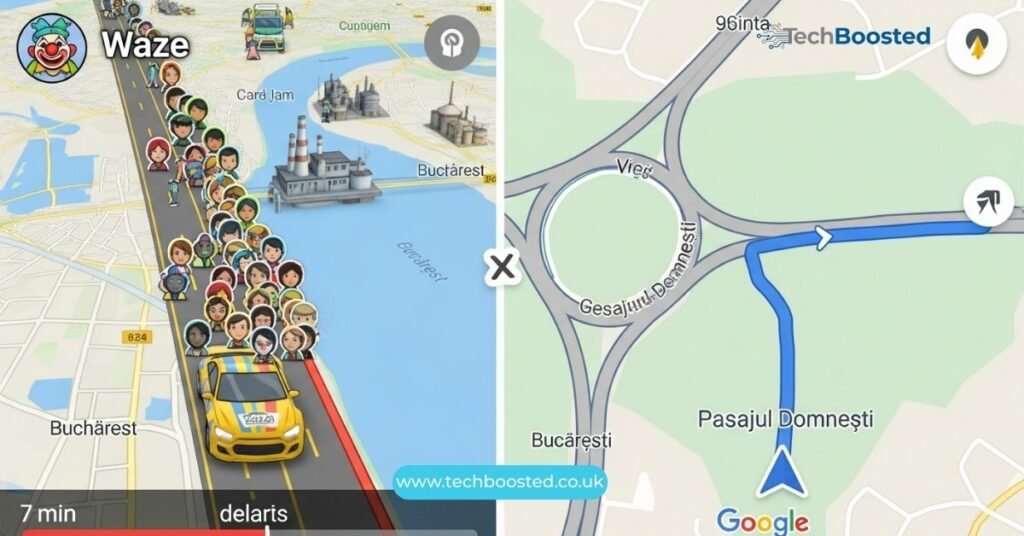
In the Waze vs Google Maps debate around route accuracy and planning, context matters. Waze often excels in heavily congested urban areas where its crowd-sourced information can help drivers avoid incidents quickly. In contrast, Google Maps tends to provide more consistent navigation across different modes of transport and varied geographies. Maps integrates historical traffic data and machine learning models that forecast traffic conditions to suggest optimal departure times and route choices. Some users have reported that Waze sometimes routes through smaller side streets or residential areas to save minutes, which may not always be optimal, especially for unfamiliar drivers. Google Maps’ strength lies in stable, predictable routing backed by extensive data sources.
User Interface and Experience: Which Is Better?
When considering Waze vs Google Maps from a user experience perspective, personal preference plays a big role. Waze’s interface is vibrant and gamified, emphasizing active alerts and community input. Drivers see icons for hazards, reports, and other drivers, making the experience interactive but sometimes visually busy. Google Maps’ interface is smoother and more streamlined, with a focus on ease of search, transit options, and informational layers like nearby businesses and street names. Users who prefer a visually rich, community-centric driving app may lean toward Waze, while those who want a more polished, multifunctional map are often happier with Google Maps.
Offline and Alternative Transport: Google Maps Strength
Another key aspect of Waze vs Google Maps is the range of transport options. Google Maps supports driving, walking, cycling, and public transit such as buses, trains, and ferries. It also offers features like bicycle paths and rideshare integration. Waze remains strictly car-centric, focusing solely on road navigation and traffic. For users who frequently navigate on foot, by bike, or on public transport, Google Maps’ broader capabilities are unmatched. For dedicated drivers, though, Waze’s specialized focus can offer a more driven experience.
Battery, Data Usage, and Technical Performance
When comparing Waze vs Google Maps in terms of battery and data usage, differences emerge based on design philosophy. Waze’s constant communication with its user base means more frequent data use and GPS activity, which can consume more battery power than Google Maps. Google Maps, by contrast, uses a combination of data sources and often requires less constant GPS polling. Neither app is ideal for extended battery life without a charger, but Google Maps’ approach tends to be less taxing in everyday use. Additionally, Google Maps’ offline map downloads can reduce data usage on long trips, while Waze’s reliance on connectivity may increase data demands.
Integration with Cars and Devices in 2026
In 2026, both Waze and Google Maps work with popular car infotainment systems such as Android Auto and Apple CarPlay, allowing hands-free navigation directly on dashboard screens. Google Maps has recently expanded support for advanced vehicle displays and multi-app views. Waze continues to integrate deeply with voice assistants on mobile devices and offers innovative features like experimental traffic light displays in some regions, enhancing on-the-road awareness. Both apps aim to keep drivers safe and informed through seamless integration, but Google Maps has a slight overall edge due to broader ecosystem interoperability with other services and devices.
Privacy, Data, and Community Influence
A subtle but important part of the Waze vs Google Maps comparison involves privacy and data usage. Waze’s community-driven model relies on active sharing of user location and road conditions, which can raise privacy concerns for some users. Google Maps also collects location data, but its aggregation is broader and often less tied to real-time social contributions. Users concerned about privacy may prefer Google Maps’ more passive data collection, while those who value live updates might prioritize Waze’s participatory approach. Both platforms implement privacy controls, but the difference in data philosophy is worth noting.
Which App Is Better for Daily Commuters?
For daily commuters weighing Waze vs Google Maps, context matters. If your typical route involves heavy traffic with frequent delays, Waze’s live, real-time alerts can help shorten travel time significantly. Its community reports can steer you away from unexpected roadworks or police checkpoints before Google Maps’ generalized alerts catch up. However, if your commute takes you through diverse transport options or includes multimodal travel like public transit or walking segments, Google Maps’ versatility makes it the better overall tool for comprehensive navigation.
Best Choice for Long-Distance Travel
When comparing Waze vs Google Maps for long-distance or multi-leg journeys, Google Maps often holds the advantage because it can plan routes that incorporate diverse transport modes, suggest stops, estimate fuel use, and even provide offline routing if necessary. Waze’s focus on real-time driving conditions remains valuable, but its dependency on internet connectivity and user reports makes it less suitable for remote stretches with fewer Waze users. For travel that involves exploration beyond urban driving, Google Maps typically offers a more robust experience.
Conclusion
In the Waze vs Google Maps debate for 2026, neither app is definitively “better” for every user each excels in different areas. Waze’s real-time, community-driven traffic updates and aggressive rerouting make it ideal for daily drivers in congested cities who want to avoid delays at all costs. Google Maps’ versatility, offline navigation, multimodal transport support, and extensive location data make it the more comprehensive navigation solution for broader travel needs. Your personal preference and primary use case should guide your choice in the Waze vs Google Maps decision whether you prioritize dynamic traffic responsiveness or a feature-rich, all-purpose mapping experience.
Frequently Asked Questions (FAQs)
Which app is better for real-time traffic: Waze vs Google Maps?
Waze generally offers more precise, user-reported traffic alerts, making it better for live traffic avoidance.
Can Waze work offline better than Google Maps?
No, Google Maps provides far superior offline navigation with full route support.
Does Waze or Google Maps drain more battery?
Waze tends to use more battery due to constant GPS and data updates.
Which app is better for public transport and walking?
Google Maps, as it supports buses, trains, cycling, and walking routes.
Are there major differences in user interface between Waze and Google Maps?
Yes Waze offers a more community-focused, interactive interface, while Google Maps uses a streamlined, multifunctional design.
Do both apps integrate with car infotainment systems?
Yes, both Waze and Google Maps work with Android Auto and Apple CarPlay.
Stay connected with Techboosted.co.uk for more comparisons and navigation tips.