
The Escalating US-China AI Rivalry: Origins and Current Flash points
The US-China AI rivalry has evolved from a niche technological competition into a full-spectrum geopolitical contest that defines the early 21st century, with both nations vying for dominance in artificial intelligence as the cornerstone of future economic, military, and societal power. Rooted in the 2017 US National Security Strategy that identified China as a strategic competitor, the rivalry intensified with the 2018 trade war and subsequent export controls on semiconductors, culminating in a series of high-stakes moves that have reshaped global tech supply chains. By 2025, this contest has reached a fever pitch, exemplified by China’s surprise launch of the DeepSeek R1 large language model on January 20, coinciding with Donald Trump’s inauguration, which challenged US assumptions about the efficacy of chip restrictions by delivering high-performance AI at a fraction of the cost of Western counterparts. The US responded with tightened export controls in January, introducing a tiered global licensing framework under the AI Diffusion Rule to curb China’s access to advanced chips and model weights, while China countered by accelerating domestic innovation through massive state-backed investments and open-source strategies that democratize AI development for emerging economies. This back-and-forth has created a bifurcated AI ecosystem, where US firms like OpenAI and Google lead in proprietary foundational models, but Chinese entities such as DeepSeek and Alibaba are closing the performance gap to mere months in generative AI, as per Insikt Group’s benchmarks, forcing a reevaluation of the rivalry’s trajectory. Beyond chips and models, the US-China AI rivalry encompasses talent flows, with China producing 50% of global AI researchers yet facing US visa restrictions, and ideological clashes over AI governance America emphasizing democratic values and safety, while Beijing prioritizes self-reliance and rapid deployment in state surveillance and manufacturing. As President Xi Jinping urged “self-reliance and self-strengthening” in April, underscoring the need to leverage China’s “new whole national system” for AI breakthroughs, the rivalry risks fracturing global standards, compelling allies like Australia and Japan to navigate dual alliances amid fears of a “digital Cold War.” With projections of AI contributing $15.7 trillion to the global economy by 2030, the stakes extend far beyond bilateral tensions, influencing everything from supply chain resilience to the ethical frameworks governing superintelligent systems.
US Strategies in the AI Rivalry: Export Controls and Private Sector Dominance
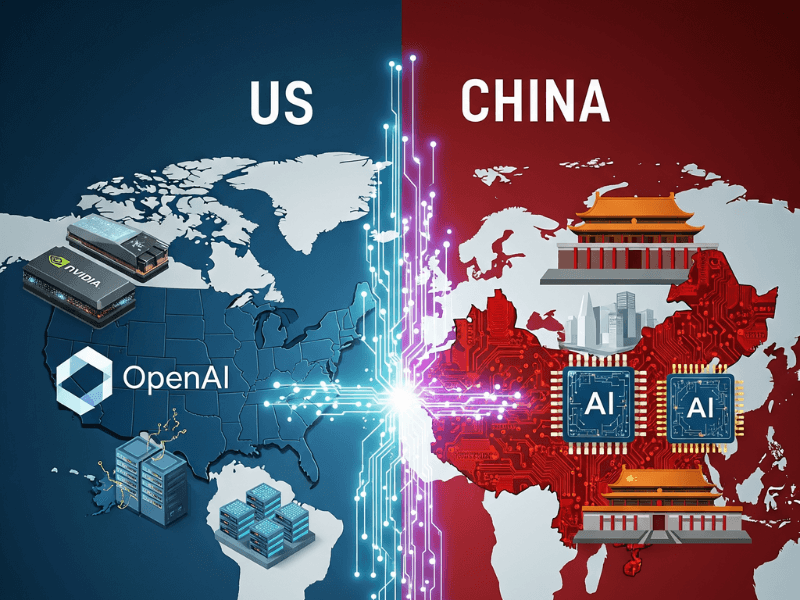
America’s approach to the US-China AI rivalry hinges on leveraging its unparalleled private sector innovation and regulatory tools to maintain a technological edge, exemplified by aggressive export controls that have evolved from the 2022 BIS restrictions on advanced semiconductors to the comprehensive January 2025 AI Diffusion Framework, which categorizes countries into tiers for chip and model weight exports, effectively blocking high-end AI hardware flows to China while exempting close allies like Japan and the UK. These measures, including the addition of over 65 Chinese entities to the Entity List in March and September, aim to starve China’s military modernization by limiting access to Nvidia’s H20 GPUs and AMD’s MI308 chips, though critics argue they inadvertently accelerate Beijing’s domestic semiconductor push, as evidenced by Huawei’s planned Ascend 910C release in May despite a 33% performance deficit. Complementing this, the US boasts 12 times China’s private AI investment at $109.1 billion in 2024, fueling hyperscalers like Microsoft and Amazon to pour hundreds of billions into data centers via initiatives like the $500 billion Stargate Project, which secures compute power as a national asset akin to oil reserves. Key players such as OpenAI (valued at $500 billion) and Anthropic ($183 billion post-funding) drive foundational model supremacy, with partnerships like OpenAI-Broadcom multimillion deals consolidating influence among a tight-knit ecosystem of chipmakers and cloud giants. Yet, this strategy faces internal pushback, as Nvidia CEO Jensen Huang warns that overzealous controls could cede markets to Huawei, potentially eroding US leadership in AI applications where diffusion not just invention determines victory. The Biden-era rules, partially rolled back under Trump but replaced by targeted restrictions, underscore a deregulatory pivot emphasizing private capital and military-aligned exports, positioning the US to out-scale rivals through alliances like the Chip 4 pact with Taiwan, Japan, and South Korea. Despite these advantages, the US lags in AI adoption metrics, with only 78% of organizations using AI in 2024 versus China’s manufacturing integration targets of 60% by year-end, highlighting a vulnerability in translating R&D prowess into economic diffusion. As the rivalry intensifies, Washington’s focus on “decisive technical superiority” through ethical AI visions risks alienating Global South partners drawn to less restrictive models, potentially fragmenting international norms.
China’s Counteroffensive: State-Driven Investments and Open-Source Disruption
China’s response to the US-China AI rivalry is a masterclass in adaptive resilience, channeling over $98 billion in 2025 AI capital expenditure 48% up from 2024 with government funding comprising up to $56 billion to foster self-sufficiency amid export chokepoints, as directed by Xi Jinping’s April call for a “new whole national system” to bridge gaps in innovation and industrial applications. This state-orchestrated push, embedded in the 14th Five-Year Plan and Made in China 2025, prioritizes massive chip clusters powered by Huawei’s Ascend series despite US bans leveraging cheap renewable energy from solar, wind, and nuclear expansions to offset inefficiencies, enabling systems like CloudMatrix 384 to rival Nvidia on select metrics at lower costs. Leading firms such as DeepSeek, with its R1 model trained on stockpiled A100s for pennies on the dollar, Alibaba’s Qwen series, and Tencent’s Hunyuan-A13B exemplify open-source strategies that outpace US closed models in accessibility, capturing developer mindshare and exporting infrastructure via the Digital Silk Road to Belt and Road nations. By mid-2025, China overtook the US in AI publications and patents, producing 40 notable models in 2024 alone, while subsidies in cities like Shanghai and Shenzhen slash data center costs, drawing firms away from Nvidia toward domestic alternatives. This approach yields tangible wins: over 60% of large manufacturers integrated AI by 2025, fueling “AI + Manufacturing” factories certified nationwide, and ventures like Moonshot AI ($3.3 billion valuation) underscore a broader ecosystem where state guidance funds quantum-AI hybrids with $138 billion over two decades. Yet, challenges persist, including a 33% GPU performance lag and opacity in R&D metrics, but China’s emphasis on applications surveillance, bioethics, and exportable models positions it to shape global standards, particularly in the Global South, where its public-good narrative contrasts US techno-nationalism.
Technological Battlegrounds: Models, Chips, and Compute Power
At the heart of the US-China AI rivalry lie three interlocking domains: foundational models, semiconductor supremacy, and compute infrastructure, where incremental edges compound into strategic dominance. US labs like OpenAI’s GPT series and Google’s Gemini hold the frontier in closed-weight models, producing 40 notable systems in 2024 versus China’s 15, bolstered by $109 billion in private funding that dwarfs Beijing’s $9.3 billion, enabling breakthroughs in multimodal AI and reasoning akin to human cognition. Conversely, China’s open-source vanguard DeepSeek’s R1, Alibaba’s Qwen-3, and Moonshot’s Kimi K2 excels in cost-efficiency and diffusion, with R1 rivaling GPT-4 on benchmarks using pre-ban Nvidia stockpiles, narrowing the gap to 3-6 months per Insikt Group data and pressuring US firms to reconsider proprietary walls. Chip warfare defines the hardware front: Nvidia’s Blackwell GPUs power US hyperscalers’ $320 billion 2025 capex, but BIS controls since 2022 expanded in January 2025 to encompass model weights and third-country diversions have throttled China’s access, limiting Huawei to 200,000 Ascend chips annually despite SMIC’s 7nm advances. Compute power amplifies these disparities: America’s Stargate initiative secures exaflop-scale clusters, while China’s $1.4 trillion tech outlay by 2030 funds Huawei clusters in subsidized energy hubs, compensating for inefficiency with scale over 500 new data centers announced in 2023-2024. This triad fuels asymmetric progress: US excels in quality (e.g., Anthropic’s Claude), China in quantity (leading AI papers/patents), with cross-pollination via US-China research ties twice any other pair sustaining mutual acceleration despite visa curbs. As both nations eye superintelligence, the battleground shifts to energy-hungry data centers, where China’s green infrastructure edge 50% of global solar could tip scales if US deregulation falters.
Geopolitical Ramifications: From Digital Cold War to Global Fractures
The US-China AI rivalry transcends bilateral friction, birthing a digital Cold War that fractures alliances, reshapes trade, and elevates AI as the arbiter of state power, with implications rippling through conflict norms, bioethics, and catastrophic risk management. US controls, peaking with mid-2025 bans on specialized AI chips, have spurred a “dual-core” global structure, hardening ideological divides and curtailing talent mobility since 2016, as Beijing pioneers techno-authoritarian systems for surveillance while Washington champions democratic safeguards. This schism forces third parties into zero-sum choices: the Chip 4 alliance bolsters US-led standards, but China’s Digital Silk Road exports open-source AI to 100+ nations, capturing the Global South and risking incompatible tech universes that balkanize innovation. Militarily, AI amplifies escalation risks PLA integration into weapons via military-civil fusion versus US drone swarms prompting calls for multilateral monitoring regimes under UN auspices to avert arms races, as warned by experts like Eric Schmidt. In bioethics, China’s AI-accelerated genomics raises “chilling” generational concerns, contrasting US caution that may cede ground, while both grapple with misuse by non-state actors in cyberattacks or bioweapons, lowering barriers once reserved for superpowers. Economically, the rivalry disrupts $ trillions in value: US private capex at $400 billion versus China’s $98 billion total, yet Beijing’s manufacturing adoption (60% by 2025) drives GDP gains, potentially leapfrogging in applications like smart cities. As alliances like APEC host Trump-Xi summits, the path forward demands layered diplomacy export frameworks, bilateral safeguards to mitigate proliferation, lest the US-China AI rivalry devolve into a multipolar tech anarchy.
Economic Impacts: Investments, Job Shifts, and Global Supply Chain Realignments
The economic fallout from the US-China AI rivalry manifests in divergent investment paradigms and seismic supply chain shifts, where America’s $109 billion private AI funding in 2024 12 times China’s fuels hyperscaler dominance but exposes vulnerabilities to Beijing’s $98 billion 2025 capex surge, blending $56 billion state subsidies with VC inflows of 287 billion yuan to capture 70% of global investment alongside the US. US strengths in foundational R&D yield high-valuation unicorns like OpenAI ($500 billion), but China’s open-source blitz DeepSeek’s R1 at shoestring costs democratizes access, boosting emerging market adoption and pressuring US firms to hybridize models for competitiveness. Job markets transform: US AI roles grow 27% via federal R&D hikes to $11.2 billion, yet offshoring risks rise as controls drive Huawei’s Ascend ecosystem, creating 500,000 domestic semiconductor jobs while US fabs under CHIPS Act lag at 40% capacity. Supply chains bifurcate: US Chip 4 secures Taiwan’s TSMC for Blackwell production, but China’s stockpiling and SMIC’s 7nm yields despite EUV bans sustain 18 new fabs, with subsidies slashing energy costs for clusters rivaling Nvidia. Globally, this rivalry unlocks $15.7 trillion by 2030 but risks decoupling losses: US hyperscalers eye $320 billion capex for Stargate, while China’s 10 trillion yuan tech pledge by 2030 integrates AI into 60% of manufacturing, accelerating GDP but inflating bubbles in overfunded startups like Moonshot ($3.3 billion). As tariffs and bans persist, allied nations like India and Vietnam emerge as neutral hubs, capturing rerouted investments and underscoring how the US-China AI rivalry catalyzes a multipolar economic order.
Ethical and Security Concerns: Surveillance, Bias, and Existential Risks
Ethical fissures in the US-China AI rivalry amplify security dilemmas, with divergent governance models US focus on transparency and bias mitigation versus China’s deployment-first ethos exacerbating global risks from surveillance proliferation to superintelligence mishaps. US frameworks like the AI Bill of Rights prioritize equitable outcomes, yet lag in state power applications where China deploys AI for mass monitoring via military-civil fusion, integrating models into PLA systems for predictive policing that raises human rights alarms. Bias concerns mount: Chinese models like Qwen reflect state narratives, potentially exporting censored realities, while US systems grapple with underrepresented data, as Stanford’s 2025 Index notes China’s lead in papers but US edge in quality. Security threats escalate with AI’s dual-use nature: both nations advance cyber tools, but controls limit China’s scale, though DeepSeek’s efficiency enables rogue actor access, lowering bioweapon or deepfake barriers per Schmidt’s warnings. Existential risks loom in the race to AGI, where US caution evident in paused model releasesvcontrasts China’s acceleration, risking “Promethean” fallout in bioethics like AI-genomics chimeras. Multilateral calls grow for UN-monitored regimes to harmonize safeguards, as the rivalry’s opacity China’s R&D black box versus US corporate secrecy fuels miscalculations, demanding layered diplomacy to avert catastrophe.
Future Trajectories: Scenarios for the Next Decade
Peering ahead, the US-China AI rivalry could unfold in three trajectories: sustained US hegemony through compute moats and alliances, a multipolar equilibrium where China’s applications dominance balances American invention, or escalatory decoupling yielding fragmented innovation. Optimistic forecasts hinge on US $400 billion capex sustaining Nvidia’s Blackwell edge, but China’s $1.4 trillion tech infusion by 2030 fueled by Huawei clusters could equalize if export loopholes close, per Brookings’ five-year outlook. By 2030, AI may add $15.7 trillion globally, with US capturing 40% via hyperscalers if deregulation prevails, while China integrates 80% of industries, exporting standards to BRICS. Pessimistic paths risk arms races, with PLA AI weapons versus US swarms, mitigated only by APEC-like forums. Hybrid scenarios favor collaboration in safety US-China research ties persist yielding shared AGI protocols, but ideological rifts may balkanize ethics, as CNAS warns of bio-revolutions under Chinese lead. Ultimately, the rivalry’s denouement depends on diffusion: US excels in creation, China in application, portending a world where AI’s benefits accrue unevenly absent guardrails.
Conclusion:
The US-China AI rivalry stands as the pivotal struggle of our era, intertwining technological prowess with geopolitical destiny, where America’s innovative vanguard clashes with China’s indomitable scale to script the contours of tomorrow’s world. From DeepSeek’s defiant launches to Nvidia’s fortified bastions, this contest illuminates the perils of unchecked competition bifurcated ecosystems, ethical voids, and existential gambles yet harbors untapped potential for collaborative stewardship if leaders prioritize multilateral norms over zero-sum triumphs. As investments balloon and models proliferate, the true victor will be the global community that harnesses AI for equitable advancement, not dominion; policymakers must forge bridges amid the breach, ensuring the intelligence revolution uplifts humanity rather than divides it.
FAQs
What sparked the US-China AI rivalry? It ignited with the 2017 US National Security Strategy labeling China a competitor, escalating via 2018 trade wars and 2022 chip export controls to curb Beijing’s military AI ambitions.
How effective are US export controls on Chinese AI development? They’ve limited high-end chip access, slowing Huawei to 200,000 units in 2025, but spurred domestic innovation like DeepSeek’s efficient models, narrowing the gap to months.
Which companies lead the US side of the AI rivalry? OpenAI, Google, Nvidia, Anthropic, and Meta dominate with foundational models and chips, backed by $109 billion in 2024 private investment.
How is China investing in AI to counter the US? With $98 billion in 2025 capex $56 billion state-led focusing on Huawei clusters, open-source models like R1, and energy subsidies for self-reliance.
What are the global risks of the US-China AI rivalry? It risks a digital Cold War, tech decoupling, AI arms races, and ethical divides, potentially fragmenting standards and amplifying misuse in cyber or bio threats.
Who is winning the US-China AI rivalry so far? The US leads in models and investment, but China excels in publications, patents, and applications, closing gaps rapidly via adaptive strategies.
Stay connected with cutting-edge analyses on global tech shifts, AI breakthroughs, and strategic rivalries at TechBoosted.co.uk – your premier destination for geopolitical tech insights.