
Table of Contents
What Is Statistical Inference
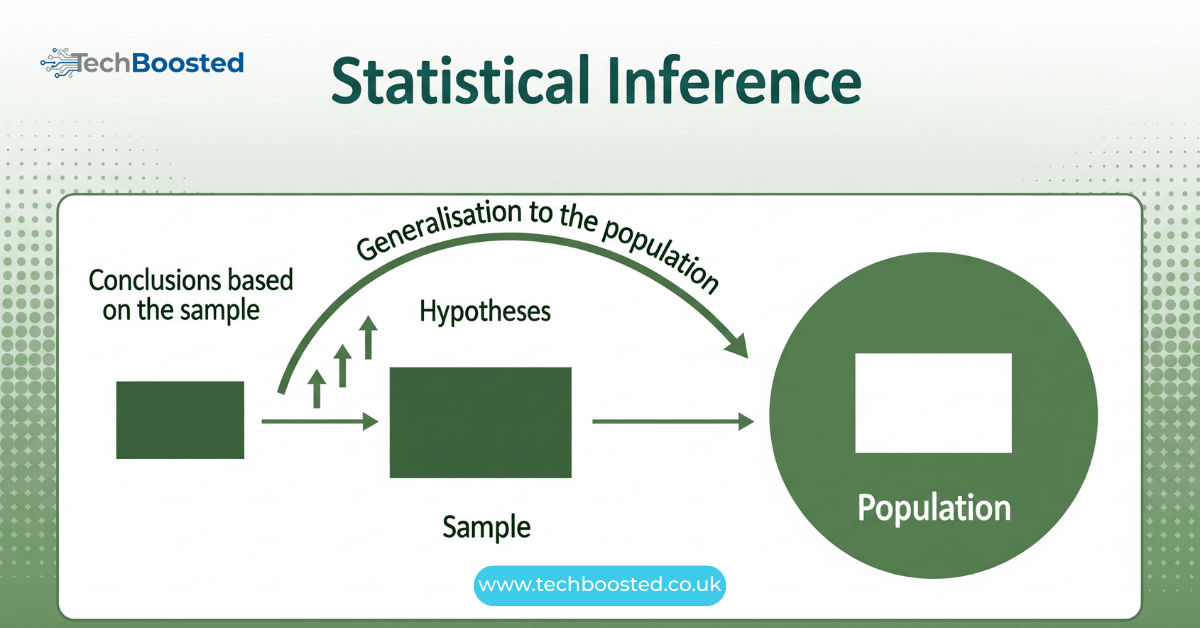
Statistical inference is the branch of statistics that enables us to make generalizations about a population based on data collected from a sample. Rather than examining every member of a population which is often impractical or impossible we use sample statistics to estimate population parameters or test hypotheses about them. This process relies on probability theory to quantify uncertainty, providing tools like confidence intervals and p-values to assess reliability. At its core, statistical inference bridges observed data and broader conclusions, forming the foundation for evidence-based decision-making in science, business, and policy.
Population vs Sample in Statistical Inference
A population includes all possible subjects or items of interest, while a sample is a subset selected for study. The goal of statistical inference is to use sample properties to infer population characteristics accurately. Sampling error the difference between sample and population values is inevitable but can be minimized through proper design. Understanding this distinction is crucial, as poor sampling leads to biased inferences, undermining conclusions.
Parameter Estimation Techniques
Statistical inference heavily features parameter estimation, where we approximate unknown population values. Point estimation provides a single best guess, such as the sample mean estimating the population mean. Interval estimation constructs ranges, like confidence intervals, that likely contain the true parameter with a specified probability (e.g., 95%). Methods like maximum likelihood estimation optimize parameters to maximize data likelihood, widely applied in modeling.
Hypothesis Testing Framework
Hypothesis testing is a cornerstone of statistical inference, allowing formal evaluation of claims. We define a null hypothesis (no effect or status quo) and an alternative hypothesis. Sample data generates a test statistic, compared against critical values or yielding a p-value the probability of observing results at least as extreme under the null. Low p-values lead to rejection, but significance does not prove causation or practical importance.
Types of Errors and Test Power
In statistical inference, Type I errors occur when rejecting a true null hypothesis (false positive), controlled by the significance level α (commonly 0.05). Type II errors happen when failing to reject a false null (false negative), reduced by increasing sample size or effect magnitude. Test power (1 – β) measures the ability to detect true effects, guiding study design for reliable results.
Confidence Intervals Explained
Confidence intervals provide a range for population parameters in statistical inference, interpreted as: if repeated samples were taken, the interval would contain the true parameter in a given percentage of cases (e.g., 95%). Wider intervals indicate more uncertainty, influenced by sample size and variability. They offer richer information than point estimates, showing precision and plausible values.
Frequentist vs Bayesian Approaches
Frequentist statistical inference treats parameters as fixed unknowns, using long-run frequencies for probabilities. Bayesian methods view parameters as random variables, updating prior beliefs with data to form posteriors via Bayes’ theorem. Bayesian inference excels in incorporating expert knowledge or handling small samples, while frequentist methods dominate traditional hypothesis testing for simplicity.
Sampling Methods and Bias Reduction
Effective statistical inference requires representative sampling. Simple random sampling gives equal chance to all, minimizing bias. Stratified sampling ensures subgroup representation. Cluster sampling selects natural groups for cost efficiency. Non-response or selection bias can distort inferences, addressed through weighting or careful design.
Non-Parametric Methods in Inference
When data violates parametric assumptions like normality, non-parametric statistical inference offers robust alternatives. Tests like Mann-Whitney U or Kruskal-Wallis compare distributions without assuming shapes. Sign tests and rank-based methods handle ordinal data or outliers effectively, sacrificing some power for flexibility.
Real-World Applications in Medicine
Clinical trials rely on statistical inference to assess treatment efficacy, using randomized samples to test drug effects against placebos. Survival analysis infers outcomes over time, while meta-analyses combine studies for stronger evidence. Regulatory approvals hinge on significant p-values and confidence intervals demonstrating safety and benefit.
Economic Forecasting and Econometrics
Economists use statistical inference in regression models to estimate relationships, like GDP impacts from policy changes. Time-series analysis infers trends and cycles. Hypothesis tests evaluate theories, such as wage disparities, informing fiscal decisions.
Machine Learning and Inference Connections
In machine learning, statistical inference evaluates model generalization via cross-validation and bootstrapping for uncertainty estimates. Inference techniques assess feature importance or prediction intervals, ensuring reliable AI deployment in critical areas like healthcare diagnostics.
Common Pitfalls and Best Practices
Misinterpreting p-values as effect probabilities or equating significance with importance are frequent errors in statistical inference. Overlooking multiple testing inflates false positives. Best practices include pre-registration, effect size reporting, and replication to enhance reproducibility.
Future Directions in Statistical Inference
Advances integrate big data, causal inference methods like propensity scoring, and computational tools for complex models. Ethical considerations emphasize transparent reporting and equitable applications.
Conclusion
Statistical inference empowers us to derive meaningful insights from limited data, driving progress across disciplines. Mastering its principles from estimation to testing equips practitioners to navigate uncertainty with rigor, ensuring conclusions are both reliable and actionable.
FAQs
What is the main goal of statistical inference?
To use sample data for conclusions about populations, estimating parameters or testing hypotheses.
How do confidence intervals work in statistical inference?
They provide ranges likely containing true parameters, with levels indicating long-run capture rates.
What is the difference between point and interval estimation?
Point gives a single value; interval a range with confidence level for uncertainty.
Why is hypothesis testing important in statistical inference?
It formally evaluates claims, quantifying evidence against null hypotheses via p-values.
What are Type I and Type II errors in statistical inference?
Type I: rejecting true null; Type II: failing to reject false null.
How does Bayesian inference differ from frequentist?
Bayesian updates priors with data for posteriors; frequentist uses fixed parameters and frequencies.
Stay connected with techboosted.co.uk for the latest data analysis tools and machine learning guides.