
Table of Contents
Sony’s PlayStation 5 has been a cornerstone of next-generation gaming, but the release of the PS5 Pro brings significant upgrades for gamers seeking higher performance, better graphics, and expanded storage. The PS5 vs PS5 Pro debate focuses on whether the mid-generation improvements justify the cost for both new buyers and existing owners. While the original PS5 already delivers immersive gameplay with fast load times and ray tracing support, the Pro version enhances GPU power, memory bandwidth, and upscaling technology. Understanding these differences in specifications, real-world performance, and value is key to deciding which console best suits your gaming setup.
Performance Overview: Core Differences Between PS5 vs PS5 Pro
The most noticeable difference in the PS5 vs PS5 Pro comparison is graphical performance. The Pro features a significantly upgraded GPU with more compute units, resulting in up to 45% faster rendering in optimized games. Frame rates are more stable, and high-resolution gaming is smoother. Memory bandwidth improvements in the Pro also contribute to faster texture loading and improved responsiveness. Both consoles share the same 8-core AMD Zen 2 CPU, but the PS5 Pro can reach slightly higher clock speeds. For gamers, this means most performance gains come from graphical upgrades rather than CPU improvements, a key factor in the PS5 vs PS5 Pro debate.
CPU and Architecture: Comparing PS5 vs PS5 Pro
In terms of processing, the PS5 vs PS5 Pro comparison shows minimal differences. Both consoles utilize a custom AMD Zen 2 8-core CPU designed for multi-threaded workloads. While the Pro can slightly boost clock speeds, real-world CPU performance differences are limited, as most modern titles rely more on GPU power. Thus, the CPU rarely bottlenecks games on either console. The architecture remains consistent between the PS5 and PS5 Pro, ensuring compatibility with current and upcoming titles. This means the key selling point in PS5 vs PS5 Pro is not processing power but graphical performance and memory enhancements, which affect 4K and potentially 8K gameplay.
GPU Comparison in PS5 vs PS5 Pro
GPU upgrades define the PS5 vs PS5 Pro performance differences. The original PS5 delivers 10.28 teraflops via its RDNA 2 GPU, whereas the Pro version reaches approximately 16.7 teraflops. This boost allows more consistent frame rates, better ray tracing, and higher visual fidelity. In games optimized for Pro hardware, environments appear sharper, lighting effects improve, and higher resolutions can be maintained. The GPU upgrade is especially beneficial in demanding AAA titles where the original PS5 may struggle to sustain 4K at 60fps. For gamers prioritizing visual quality, the PS5 vs PS5 Pro GPU difference is a major factor in choosing the right console.
Memory and Bandwidth Upgrades
Memory plays a pivotal role in the PS5 vs PS5 Pro comparison. Both consoles include 16GB of GDDR6 RAM, but the Pro offers roughly 576GB/s memory bandwidth versus 448GB/s in the standard PS5. This faster throughput allows for smoother texture rendering, quicker load times, and enhanced responsiveness in open-world games. The improvements reduce stuttering and texture pop-in, creating a more seamless experience. For hardcore gamers who demand high-fidelity visuals and fluid performance, these memory upgrades make the PS5 vs PS5 Pro difference noticeable during intense gameplay sessions.
Internal Storage: Capacity and Expansion
Another key point in the PS5 vs PS5 Pro debate is storage. The base PS5 ships with 825GB or 1TB SSD, while the Pro comes standard with 2TB. This additional space allows players to store more AAA games without frequently managing library installs. Both consoles support NVMe SSD expansion and external USB drives, but the Pro’s 2TB capacity is advantageous for digital-only gamers. Faster storage access also helps load times and in-game asset streaming. Therefore, the PS5 vs PS5 Pro comparison strongly favors the Pro for players with extensive game libraries who prioritize convenience and speed.
Upscaling Technology in PS5 vs PS5 Pro
Sony has introduced advanced upscaling technology in the Pro to improve PS5 vs PS5 Pro visual performance. Using PlayStation Spectral Super Resolution (PSSR), similar to NVIDIA’s DLSS, games can render at lower internal resolutions and upscale intelligently to near-native 4K. This improves frame rates without sacrificing visual quality. Titles optimized for the Pro benefit from higher fidelity graphics and smoother gameplay, making PSSR a defining feature in the PS5 vs PS5 Pro comparison. For users with 4K TVs, this feature enhances immersion while balancing performance and visual clarity effectively.
Real-World Gaming Performance
In real gameplay tests, the PS5 vs PS5 Pro comparison shows the Pro consistently maintaining higher frame rates and stable 4K performance in optimized titles. Games like Horizon Forbidden West and Marvel’s Spider-Man 2 demonstrate smoother frame pacing and improved texture quality. However, not all titles benefit equally; older or non-optimized games may show marginal improvements. For competitive gamers and enthusiasts, the PS5 vs PS5 Pro difference is most pronounced in performance-heavy or visually demanding games, making the Pro a more attractive option for high-end gaming setups.
8K Support and Connectivity
The PS5 Pro adds features like 8K output, Wi-Fi 7, and Variable Refresh Rate (VRR), giving it an edge in the PS5 vs PS5 Pro comparison. While 8K gaming is currently rare, the capability ensures future-proofing for next-generation displays. VRR reduces screen tearing and enhances gameplay smoothness, particularly on high-refresh-rate TVs. These advanced features make the Pro appealing for gamers seeking the latest technologies and better integration with premium display hardware, strengthening its position in the PS5 vs PS5 Pro debate.
Backward Compatibility and Game Boost
Both consoles are backward compatible with PS4 games, but the PS5 vs PS5 Pro comparison highlights Game Boost technology on the Pro. Thousands of legacy titles benefit from smoother frame rates and improved resolution. This feature enhances older games without requiring developer updates, extending the value of existing libraries. For players with extensive collections, this makes the Pro a more versatile and appealing choice when comparing PS5 vs PS5 Pro capabilities.
Design and Form Factor Differences
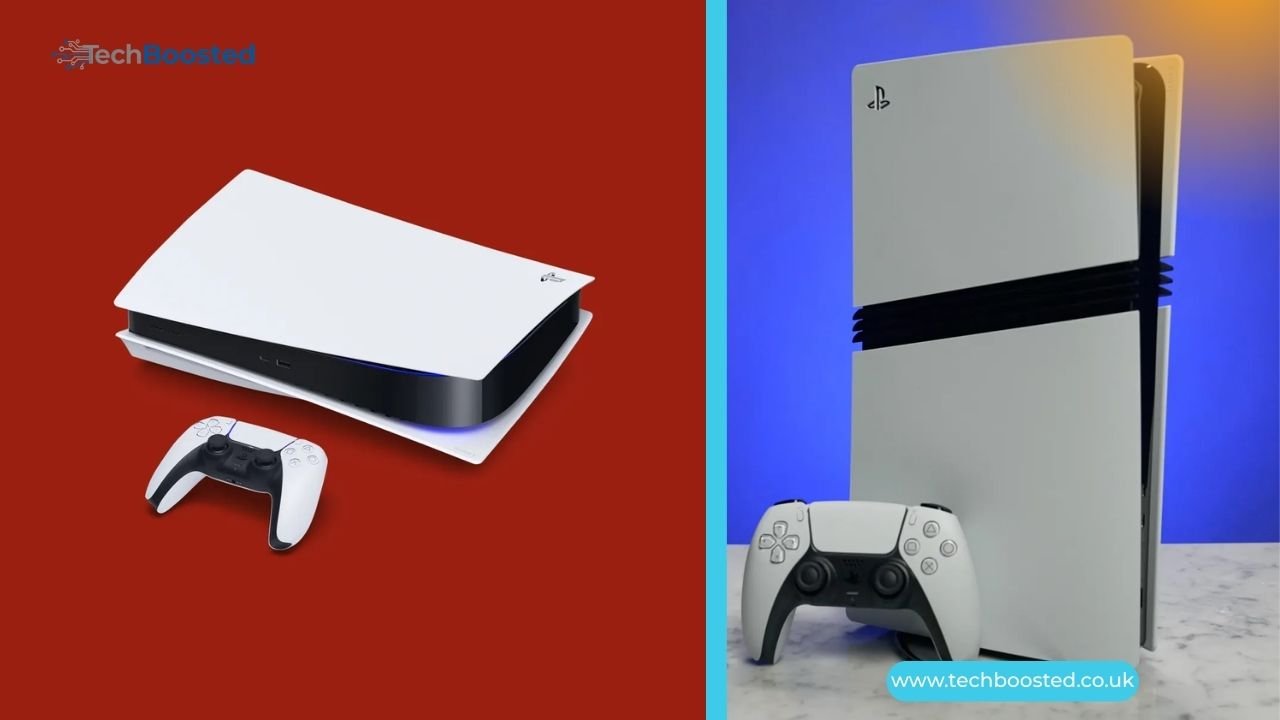
Cosmetically, the PS5 Pro retains the iconic PS5 design but is slightly slimmer and more streamlined. Some Pro models omit the optical drive, reflecting the trend toward digital content. Both consoles maintain compatibility with existing controllers and accessories. While design is not a decisive factor in PS5 vs PS5 Pro, subtle changes in size, heat management, and port layouts may influence certain buyers, particularly those with limited space or specific setup preferences.
Price and Value Considerations
The Pro carries a premium launch price, around $699/£699, compared to the standard PS5. When evaluating PS5 vs PS5 Pro, price vs. performance is crucial. Hardcore gamers with high-end displays may find the upgrades worth the investment, while casual players may find the original PS5 sufficient. Factors such as graphical fidelity, frame rate stability, storage capacity, and future-proofing should guide purchasing decisions in the PS5 vs PS5 Pro debate, ensuring buyers select the console that best aligns with their needs and budget.
Who Should Buy PS5 vs PS5 Pro
New gamers entering the PlayStation ecosystem may benefit most from the PS5 Pro due to its enhanced performance, storage, and graphics. Existing PS5 owners without 4K or 120Hz setups may not see sufficient improvement to justify the upgrade. Enthusiasts and competitive players who want the best performance and graphical quality will likely favor the Pro. Understanding personal priorities—such as 4K gaming, storage needs, and future-proofing—is essential when weighing PS5 vs PS5 Pro, helping gamers make informed decisions.
Conclusion
The PS5 vs PS5 Pro comparison reveals clear advantages for the Pro in GPU power, memory bandwidth, storage, and upscaling technology. CPU performance remains largely similar, but graphical improvements significantly enhance 4K and high-fidelity gameplay. While price considerations and display compatibility influence value, the Pro model is ideal for gamers seeking long-term investment in performance, future-proofing, and visual quality. Ultimately, the choice between PS5 vs PS5 Pro depends on individual priorities, but the Pro delivers a premium experience for those wanting the latest and greatest in console gaming.
Frequently Asked Questions (FAQs)
How much more powerful is the PS5 Pro GPU?
The PS5 Pro GPU has around 45% more raw power than the standard PS5.
Does PS5 Pro support 8K gaming?
Yes, it includes 8K output support, VRR, and Wi-Fi 7.
Can PS5 games be played on PS5 Pro?
Yes, all PS5 and most PS4 titles are compatible.
Is upgrading to PS5 Pro worth it?
Yes, if you value higher frame rates, 4K fidelity, and future-proof features.
Do all games benefit from PS5 Pro hardware?
Not all; benefits depend on developer optimization and game engine support.
Is load time faster on PS5 Pro?
Yes, thanks to a larger SSD and faster memory, load times are improved.
Stay connected with Techboosted.co.uk through our latest gaming insights.