
Table of Contents
Modern gaming demands high resolutions, realistic lighting, and smooth frame rates, but achieving all three at once has always required extremely powerful hardware. This is where Nvidia’s DLSS enters the picture as a revolutionary solution. Instead of forcing GPUs to render every pixel traditionally, this AI-driven technology intelligently reconstructs images to deliver impressive visual quality while dramatically improving performance.
Gamers today expect seamless experiences whether they play at 1440p, 4K, or even higher resolutions. Traditional rendering methods often struggle to keep up with these expectations, especially in graphically demanding titles. By combining artificial intelligence with advanced graphics processing, this innovation changes how frames are generated, allowing players to enjoy sharper visuals and smoother gameplay without constant hardware upgrades.
What Is DLSS and How It Works
At its core, Nvidia’s DLSS (Deep Learning Super Sampling) is an AI-based rendering technique that uses machine learning to upscale lower-resolution images into higher-resolution outputs. Instead of rendering a frame in full 4K, the GPU renders fewer pixels and then uses trained neural networks to reconstruct missing detail with remarkable accuracy.
This process relies on dedicated AI hardware found in RTX graphics cards. The algorithm compares rendered frames to trained reference images and predicts how the final frame should look, producing results that often match or exceed native rendering quality. The result is a balance between performance efficiency and visual fidelity that traditional upscaling methods cannot achieve.
The Evolution of DLSS Over the Years
When the first version launched, some players were skeptical about AI-driven image reconstruction. Early implementations focused heavily on performance gains but occasionally struggled with fine detail and sharpness. Over time, updates introduced better training models, improved motion handling, and significantly enhanced clarity.
Newer iterations refined how data is processed frame by frame, reducing artifacts and improving stability in fast-moving scenes. These advancements demonstrate how AI-based rendering evolves continuously, learning from vast datasets to provide increasingly realistic visuals while maintaining strong performance benefits.
AI-Powered Upscaling Explained
Unlike conventional upscaling that simply stretches pixels, Nvidia’s DLSS uses deep learning to analyze patterns, edges, and textures. The system predicts how high-resolution images should appear based on prior training, effectively “filling in” visual data in a smarter way.
This intelligent reconstruction allows games to maintain crisp details such as reflections, shadows, and fine textures. Because the GPU renders fewer pixels initially, it saves valuable resources, which translates directly into higher frame rates and improved responsiveness during gameplay.
How DLSS Boosts Gaming Performance
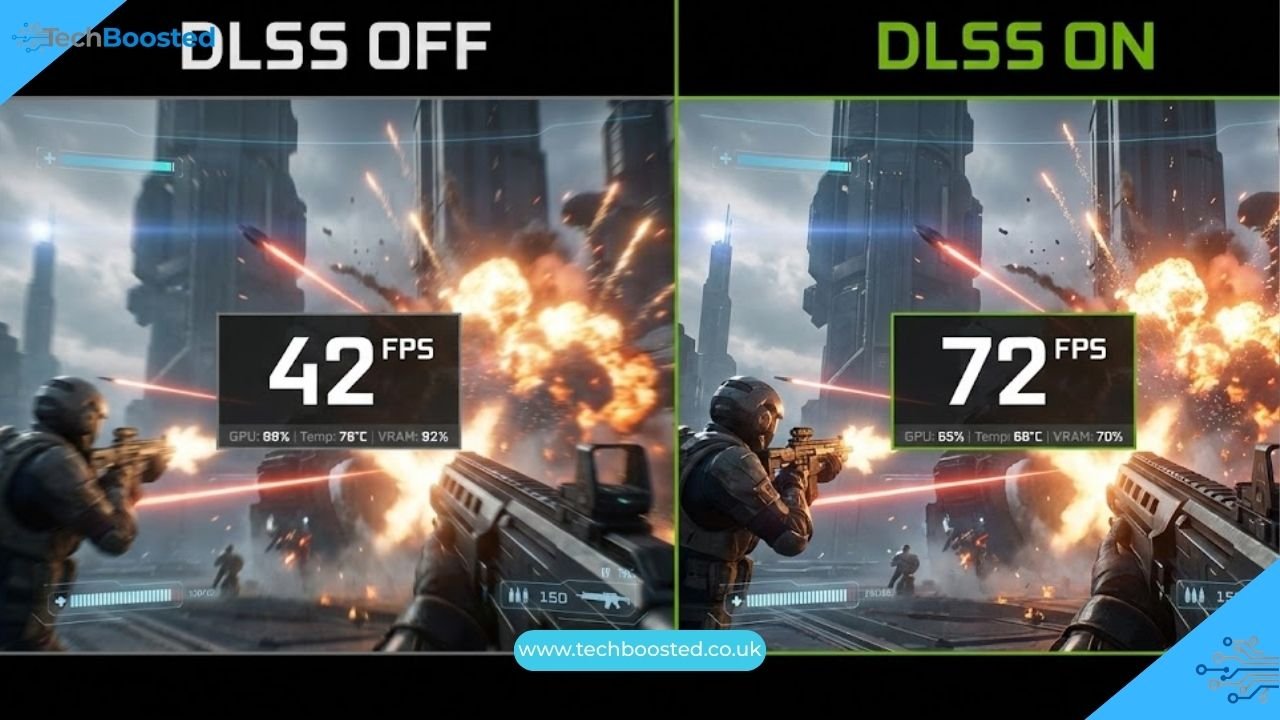
Performance improvement is one of the biggest reasons gamers enable Nvidia’s DLSS in supported titles. By reducing the workload on the GPU, the system can process frames faster, allowing smoother gameplay even in visually demanding environments.
This boost is especially noticeable in games that feature ray tracing, which traditionally requires massive computational power. AI-assisted rendering offsets that cost, letting players enjoy advanced lighting effects without sacrificing performance or stability.
Visual Quality vs Native Resolution
One common concern among gamers is whether AI upscaling compromises image quality. Surprisingly, many comparisons show that Nvidia’s DLSS can deliver visuals nearly indistinguishable from native resolution, and in some cases even sharper due to improved anti-aliasing.
Because the neural network is trained using high-quality reference images, it can reconstruct edges and textures more intelligently than traditional rendering pipelines. This leads to smoother lines, reduced jagged edges, and an overall cleaner presentation.
DLSS and High-Resolution Gaming (4K & Beyond)
High-resolution gaming has historically required expensive hardware to maintain playable frame rates. With Nvidia’s DLSS, gamers can experience 4K-level visuals without needing top-tier GPUs constantly running at maximum load.
As display technology continues advancing toward 8K and ultrawide formats, AI-driven rendering becomes even more important. It ensures that future resolutions remain accessible by optimizing how frames are generated instead of brute-forcing every pixel.
Supported GPUs and System Requirements
To take advantage of Nvidia’s DLSS, users need RTX-series graphics cards equipped with Tensor Cores designed specifically for AI workloads. These specialized components handle the deep learning calculations required for real-time image reconstruction.
Beyond hardware compatibility, players must use games that integrate the feature at the engine level. Fortunately, more developers continue adopting the technology, making it increasingly common across modern PC gaming libraries.
DLSS in Modern Game Titles
Many recent AAA titles include support for Nvidia’s DLSS, recognizing the performance and visual benefits it offers. Developers integrate it directly into their rendering pipelines to ensure players with compatible hardware get the best possible experience.
This growing adoption reflects a broader industry trend toward AI-assisted graphics. As more studios optimize their engines around this technology, it becomes less of an optional feature and more of a standard performance solution.
Comparing DLSS with Other Upscaling Technologies
While several upscaling methods exist, Nvidia’s DLSS stands out due to its reliance on deep learning rather than traditional scaling algorithms. Competing techniques may improve performance, but they typically lack the predictive intelligence that AI-based reconstruction provides.
The difference becomes clear in motion clarity, texture stability, and artifact reduction. AI-driven rendering adapts dynamically to scenes, ensuring consistent image quality even during fast gameplay sequences.
Benefits of Using DLSS for Gamers
Gamers benefit from higher frame rates, improved responsiveness, and better thermal efficiency when using Nvidia’s DLSS. Because the GPU works smarter rather than harder, systems generate less heat and consume less power while delivering strong performance.
Another advantage lies in extending the lifespan of existing hardware. Players can enjoy newer, more demanding games without needing immediate upgrades, making this technology both cost-effective and performance-focused.
Limitations and Challenges of DLSS
Despite its advantages, Nvidia’s DLSS is not without limitations. It requires developer implementation, meaning not every game supports it. Additionally, results can vary depending on how well the feature is integrated into a specific title.
There is also ongoing discussion about balancing AI reconstruction with artistic intent. Developers must carefully tune models to ensure the final image matches their visual design while still benefiting from performance gains.
Future of AI Rendering in Gaming
The success of Nvidia’s DLSS signals a major shift toward AI-assisted graphics pipelines. Future rendering systems are expected to rely even more heavily on machine learning to optimize lighting, geometry, and frame generation.
As AI models grow more advanced, real-time graphics may become less dependent on raw hardware power and more focused on intelligent reconstruction. This transition could redefine how games are developed and experienced in the years ahead.
Tips to Optimize DLSS Settings for Best Performance
To get the most out of Nvidia’s DLSS, players should experiment with different quality modes such as Performance, Balanced, or Quality depending on their hardware and resolution goals. Each mode adjusts how aggressively the AI reconstructs frames.
Fine-tuning in-game settings alongside DLSS can further enhance results. Combining optimized graphics options with AI upscaling ensures smoother gameplay while maintaining impressive visual clarity.
Why DLSS Matters for the Next Generation of Gaming
As gaming technology advances, rendering demands continue to grow exponentially. Nvidia’s DLSS provides a scalable way to meet those demands without requiring constant leaps in hardware performance.
By bridging the gap between graphical ambition and practical performance, this technology ensures that future games remain accessible, visually stunning, and efficient across a wide range of systems.
Conclusion
The rise of AI-driven rendering marks a turning point in how games are built and experienced, and Nvidia’s DLSS stands at the center of that transformation. By combining machine learning with advanced GPU architecture, it allows systems to deliver higher resolutions and smoother performance without overwhelming hardware limitations. This balance between efficiency and visual excellence makes it one of the most important innovations in modern PC gaming. As developers continue embracing AI-assisted pipelines, players can expect richer worlds, faster frame rates, and longer-lasting hardware relevance. Ultimately, this technology is not just an enhancement—it represents the future direction of real-time graphics and interactive entertainment.
Frequently Asked Questions
What is Nvidia’s DLSS?
It is an AI-powered upscaling technology that improves performance while maintaining high image quality.
Does DLSS increase FPS?
Yes, it boosts frame rates by rendering fewer pixels and reconstructing them intelligently.
Is DLSS better than native resolution?
In many cases it delivers comparable or even sharper visuals with better performance.
Do all games support DLSS?
No, only games that integrate the feature can use it.
Do you need RTX graphics cards for DLSS?
Yes, it requires RTX GPUs with dedicated AI-processing Tensor Cores.
Stay updated with the latest gaming technologies, performance guides, and AI-driven innovations at techboosted.co.uk.