

What Are Hydraulic Brakes?
Hydraulic brakes represent one of the most significant advancements in vehicle stopping technology. They operate by using brake fluid an incompressible liquid to transmit force from the driver’s pedal to the braking mechanisms at each wheel. This system ensures smooth, powerful, and consistent deceleration, making it the preferred choice for modern cars, motorcycles, bicycles, and even aircraft. By applying Pascal’s principle, even a light press on the pedal can generate substantial clamping force at the wheels, far superior to older cable-based systems in terms of responsiveness and reliability.
The Evolution and History
The journey of hydraulic brakes began in the early 20th century, with early concepts emerging around 1910 and practical implementations in the 1920s. Pioneers like Lockheed refined the technology, leading to its standard fitment in automobiles by the mid-1930s. Over decades, enhancements such as dual master cylinders for redundancy and integration with anti-lock systems have solidified their role. In 2025, they continue to dominate, adapting seamlessly to hybrid and electric vehicles.
Detailed Functioning of the System
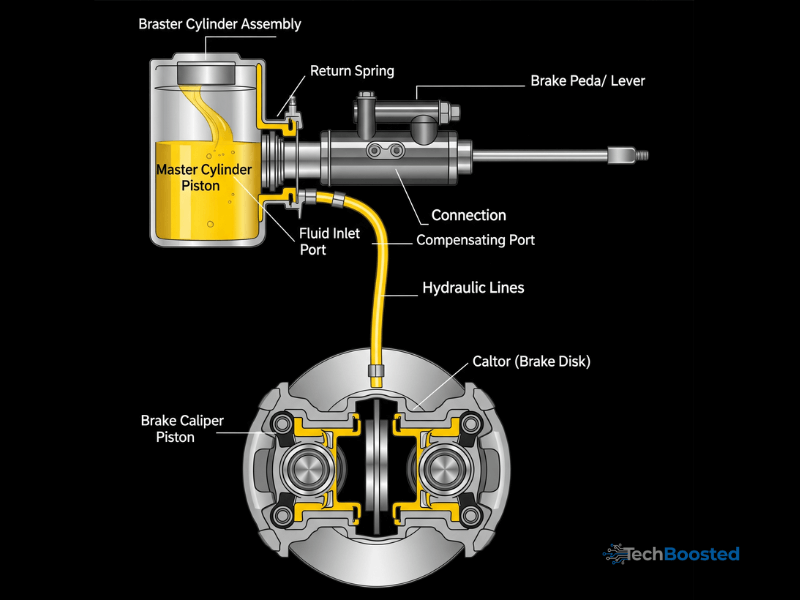
When you depress the brake pedal, it actuates a piston in the master cylinder, compressing the brake fluid and building pressure that travels instantaneously through dedicated lines to the wheel units. In disc brake setups the most common today this pressure pushes caliper pistons to squeeze pads against spinning rotors, converting motion into heat via friction. Drum variants expand shoes outward against internal surfaces. The beauty lies in the uniform pressure distribution, enabling balanced braking across all wheels regardless of load or speed.
This comprehensive process encompasses pedal linkage for ergonomic input, booster assistance (vacuum or hydraulic) to multiply force with minimal effort, sealed reservoirs maintaining fluid volume and allowing thermal expansion, braided or steel lines resisting high pressures while flexible hoses handle suspension travel, multi-piston calipers for even pad wear and reduced heat buildup, ventilated rotors aiding cooling during repeated hard stops, return springs ensuring prompt release to prevent drag, and electronic sensors feeding data to ABS modules that pulsate pressure to avoid lockup collectively delivering progressive feel, fade resistance, and emergency stopping capability that has saved countless lives on roads worldwide.
Core Components Explained
Key parts include the master cylinder with its reservoir, brake lines and hoses, calipers or wheel cylinders, friction materials (pads or shoes), and rotating elements (rotors or drums). Supporting features like proportioning valves optimise front-rear bias, while boosters reduce required pedal force. The choice of brake fluid typically glycol-based DOT specifications plays a critical role in maintaining high boiling points and system integrity.
Key Advantages
Hydraulic brakes excel in providing modulated control, allowing drivers to apply just the right amount of stopping force. They distribute power evenly, resist fade on steep descents, and demand less physical effort. In wet conditions or high-performance scenarios, their consistency outperforms alternatives, contributing to overall vehicle safety.
Possible Limitations
While highly effective, these systems can suffer from fluid contamination by moisture, leading to reduced boiling points and corrosion. Leaks compromise performance dramatically, and air ingress creates a spongy pedal feel. Regular upkeep is essential to mitigate these risks.
Hydraulic vs. Mechanical Systems
Compared to mechanical brakes, which rely on cables and rods, hydraulic versions offer greater power multiplication, better weather resistance, and finer control. Mechanical setups remain viable for simplicity in low-demand applications like basic bicycles, but hydraulics prevail where precision matters.
Wide-Ranging Applications
From daily commuter cars and sport motorcycles to downhill mountain bikes and commercial aircraft landing gear, hydraulic brakes find use wherever reliable stopping is paramount. Their adaptability supports integration with modern regenerative braking in EVs.
Practical Maintenance Advice
Monitor brake fluid levels and clarity routinely, flush and replace it every two to three years, inspect lines for damage, and replace worn pads promptly. Bleeding the system removes trapped air, restoring firm pedal response. Professional servicing ensures compliance with safety standards.
Trends Shaping the Future
As of 2025, electro-hydraulic and brake-by-wire technologies are enhancing traditional systems with faster response and seamless ADAS integration. While fully electronic braking looms, the proven reliability of hydraulics ensures their continued relevance.
Conclusion
Hydraulic brakes stand as a testament to ingenious engineering, delivering safe, efficient stopping power through simple yet effective fluid principles. Their widespread adoption underscores benefits in performance and control, with proper care maximizing longevity and safety on the road.
FAQs
What fundamental principle powers hydraulic brakes?
Pascal’s law, which transmits applied pressure uniformly through confined fluid.
How frequently should brake fluid be changed?
Generally every 2-3 years to prevent moisture-related degradation.
Can these systems fail suddenly?
Severe leaks may cause loss of braking, though modern dual-circuit designs limit it to partial function.
What causes a spongy brake pedal?
Typically air bubbles in the fluid lines or absorbed moisture lowering effectiveness.
Are hydraulic brakes ideal for bicycles?
Absolutely, especially disc types, offering superior modulation and power in demanding terrain.
How do they differ from air brakes?
Hydraulics use liquid for lighter vehicles; air (pneumatic) suits heavy trucks for safety in case of leaks.
Stay connected with us for the latest updates on vehicle safety tech and in-depth guides at techboosted.co.uk!