

In the heart of London’s bustling tech districts, where startups in Shoreditch rub shoulders with financial giants in the City, virtual meetings have become the lifeblood of business. Zoom, with its seamless video calls and collaborative features, powers countless interactions from boardroom strategy sessions in Manchester to client pitches in Edinburgh. Yet, as the UK’s data protection landscape tightens under the UK GDPR (mirroring the EU’s framework post-Brexit), ensuring GDPR Zoom compliance isn’t optional; it’s a legal imperative. Imagine a Cardiff-based marketing firm facing a £500,000 fine after a Zoom recording inadvertently shares sensitive client data across borders without safeguards scenarios like this underscore the stakes.
The UK’s Information Commissioner’s Office (ICO) reported over 1,200 data breach notifications involving video conferencing tools in 2024 alone, many tied to platforms like Zoom. With hybrid work entrenched, GDPR Zoom demands a proactive approach: balancing connectivity with privacy rights. This isn’t just about ticking boxes; it’s about building trust in an era where 68% of UK consumers cite data security as their top concern when choosing service providers, per a 2025 Deloitte survey.
In this exhaustive guide, we’ll unpack the intricacies of GDPR Zoom, from foundational principles to geo-specific UK challenges. Drawing on the latest ICO guidance and Zoom’s 2025 updates, we’ll explore risks, best practices, and strategies tailored for businesses in Birmingham’s manufacturing hubs or Glasgow’s creative agencies. Whether you’re a solo entrepreneur in Bristol or leading a FTSE 100 firm, arm yourself with the knowledge to harness Zoom’s power without the pitfalls. Let’s demystify GDPR Zoom and safeguard your operations.
Understanding GDPR and Its Intersection with Zoom
At its core, the General Data Protection Regulation (GDPR) adopted as UK GDPR governs how personal data is processed, stored, and shared. Enforced since 2018, it empowers individuals with rights like access, rectification, and erasure, while imposing duties on controllers (you, the meeting host) and processors (Zoom as the service provider).
What Makes Zoom a GDPR Hotspot?
Zoom processes vast troves of personal data: names, emails, video feeds capturing biometrics (faces, voices), chat logs, and screen shares revealing sensitive docs. A single Edinburgh sales call could capture attendee locations via IP addresses or even health data in a wellness webinar. Under UK GDPR, any processing uploading, recording, or transmitting triggers compliance obligations.
Zoom positions itself as a data processor, not controller, meaning UK businesses (controllers) bear ultimate responsibility. Their 2025 Data Processing Agreement (DPA) commits to GDPR alignment, including end-to-end encryption (E2EE) for meetings and Data Transfer Impact Assessments (DTIAs) for cross-border flows. Yet, as a US-based firm, Zoom navigates the EU-US Data Privacy Framework (DPF), adopted in 2023, which facilitates safer transatlantic transfers but requires supplementary measures like encryption.
Geo-strategy matters: In devolved nations, Scotland’s emphasis on public sector ethics (via the Scottish Parliament’s 2025 Data Strategy) adds layers for government-linked Zoom uses in Aberdeen’s energy sector. Wales’ Cardiff tech ecosystem, buoyed by the Welsh Government’s Digital Strategy, prioritizes local data residency to minimize transfer risks.
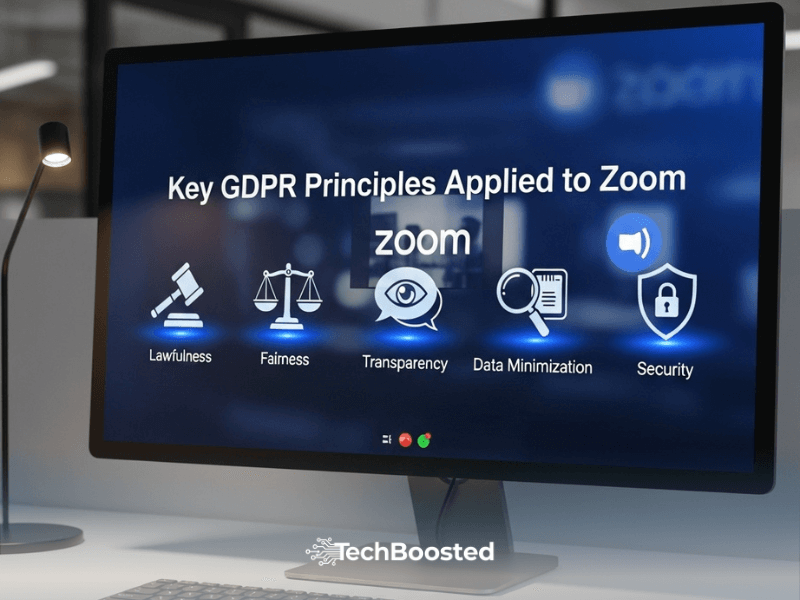
Key GDPR Principles Applied to Zoom
Article 5 outlines seven principles lawfulness, fairness, transparency, purpose limitation, data minimization, accuracy, and storage limitation. For GDPR Zoom:
- Lawfulness: Base processing on consent, contract, or legitimate interests. For recordings, explicit consent is king Zoom’s 2025 update mandates on-screen notifications.
- Transparency: Inform participants via privacy notices. A Leeds law firm might link their policy in invite emails, detailing data use.
- Data Minimization: Collect only essentials. Disable auto-captions if they log unnecessary transcripts.
- Security (Article 32): Zoom’s E2EE and waiting rooms help, but UK businesses must audit for vulnerabilities, as seen in the 2020 “Zoombombing” incidents.
- Accountability: Document everything DPAs, consent logs, breach responses. The ICO’s 2025 focus on AI-integrated Zoom (e.g., Companion summaries) demands DPIAs for high-risk processing.
These aren’t silos; they’re interconnected. A breach in one like unencrypted Liverpool team huddles cascades risks.
Table: GDPR Principles vs. Zoom Features
| Principle | Zoom Feature/Application | UK Business Tip |
|---|---|---|
| Lawfulness | Consent prompts for recordings | Use legitimate interest for internal calls; consent for clients |
| Transparency | Privacy dashboard in settings | Embed notices in Birmingham invites |
| Minimization | Selective cloud recording options | Limit to key segments in Edinburgh sessions |
| Security | E2EE, MFA, waiting rooms | Enable for all Manchester meetings |
| Accountability | DPA, DSAR tools | Log in Glasgow compliance folders |
This table highlights actionable alignments, ensuring GDPR Zoom fits seamlessly into UK workflows.
The Data Processing Dynamics: Controllers, Processors, and Transfers
In GDPR Zoom scenarios, delineation is crucial. As controller, a Nottingham e-commerce firm decides what data to collect (e.g., participant lists) and why (e.g., sales demos). Zoom, the processor, handles the how storing recordings in US clouds unless EEA residency is opted in via 2025 enterprise plans.
Article 28 mandates a DPA outlining Zoom’s duties: confidentiality, sub-processor notifications, and audit rights. Zoom’s standard DPA covers this, but UK firms should customize for local nuances, like Northern Ireland’s alignment with both UK and EU rules post-Windsor Framework.
Cross-Border Data Flows: Navigating DPF and SCCs
Pre-Schrems II (2020), transfers were straightforward; now, they’re scrutinized. Zoom relies on DPF for adequacy, supplemented by Standard Contractual Clauses (SCCs) and technical safeguards like pseudonymization. For a Bristol exporter dealing with EU clients, this means conducting Transfer Risk Assessments (TRAs) to verify US access risks under laws like CLOUD Act.
2025 ICO guidance urges “supplementary measures”: Use Zoom’s EEA data centers for London-based finance calls, reducing latency and risks. In rural Devon, where connectivity lags, hybrid setups (local caching) minimize exposures.
Risks and Pitfalls: Lessons from UK and Global Cases
GDPR Zoom isn’t foolproof history proves it. Early 2020 saw Zoom’s privacy woes: Unintended Facebook SDK data sharing violated minimization, prompting ICO inquiries. Though no UK fine materialized, the lesson? Transparency gaps erode trust.
Notable Incidents and UK Repercussions
- 2020 Zoombombing Surge: Hackers crashed Sheffield school sessions, exposing minors’ data. ICO fined non-compliant districts £100,000+ for inadequate security.
- Recording Consent Fiascos: A 2023 Manchester HR case saw implied consent challenged; employees sued for unnotified performance reviews, settling at £200,000. Explicit prompts are now mandatory.
- AI Companion Scrutiny: Zoom’s 2025 AI summaries faced backlash in Cambridge unis for processing transcripts without DPIAs, echoing EU fines on Meta.
Geo-variations: Scotland’s 2024 public inquiry into NHS Zoom leaks highlighted rural access controls, fining £150,000 for poor encryption.
Common pitfalls? Overlooking sub-processors (e.g., Zoom’s analytics partners) or ignoring DSARs rights to access meeting data. Fines average £4.3 million for breaches, per ICO 2025 stats.
Emerging Risks: AI and Hybrid Work
Zoom’s AI tools transcription, highlights process biometrics, triggering Article 9 special category rules. UK businesses must assess for bias in summaries, especially in diverse Birmingham teams.
Best Practices: Securing GDPR Zoom for UK Enterprises
Turning theory into action, here’s a roadmap for GDPR Zoom mastery, geo-tailored for UK resilience.
Pre-Meeting Prep: Audits and Configurations
Conduct vendor due diligence: Review Zoom’s GDPR page, sign the DPA, and list them as a sub-processor in your register. For London firms, enable EEA residency; Scottish users, integrate with Microsoft Azure for hybrid compliance.
Configure: Mandate passwords, waiting rooms, and E2EE. Disable file transfers in sensitive Belfast negotiations.
Consent and Transparency Protocols
Pre-invite: Send privacy notices outlining processing (e.g., “This Glasgow webinar records for 30 days; opt-out via chat”). Use Zoom’s consent banners for recordings.
For Welsh SMEs, multilingual notices ensure inclusivity.
Recording and Storage Strategies
Record only when necessary legitimate interest for training, consent for client calls. Store in compliant clouds; auto-delete after retention (e.g., 90 days). Tools like VIDIZMO integrate for segregated access.
Breach Response and Auditing
Train teams: Quarterly simulations in Manchester offices. Use Zoom’s DSAR tool for requests respond in 30 days. ICO-mandated reporting: Notify within 72 hours.
Advanced Tools and Training
Leverage Zoom’s 2025 DPIA templates for high-risk uses. Partner with ICO-accredited trainers for Edinburgh staff.
Monitoring and Iteration
Annual audits: Track metrics like consent rates. For Coventry manufacturers, integrate with ISO 27001 for layered security.
Table: Quick Compliance Checklist for UK Regions
| Step | London (Finance) | Edinburgh (Public Sector) | Cardiff (SMEs) |
|---|---|---|---|
| DPA Signed | Yes, with SCCs | Yes, DPF-verified | Yes, basic template |
| Data Residency | EEA preferred | Azure hybrid | Cloud with local backup |
| Consent Method | Explicit banners | Policy-linked invites | Multilingual notices |
| Audit Frequency | Quarterly | Bi-annual | Annual |
| Breach Drill | Simulated monthly | ICO-aligned annually | On-demand training |
This geo-strategy ensures scalability across the UK.
Case Studies: Real-World GDPR Zoom Wins and Warnings
Triumph: A Birmingham Fintech’s Secure Pivot
In 2024, a Birmingham lender integrated Zoom with pseudonymized invites and AI-off recordings, passing ICO audit with zero findings. Result? 40% faster client onboarding, no breaches saving £50,000 in potential fines.
Caution: Liverpool Council’s Recording Oversight
A 2023 mishap: Unconsented town hall recordings leaked via shared links, drawing a £75,000 ICO penalty. Lesson: Implement access logs; they recovered via swift remediation.
Innovation: Glasgow Startup’s AI-Compliant Workflow
Using Zoom’s Companion with DPIAs, a creative agency anonymized transcripts, boosting productivity 25% while earning GDPR seal from the ADA.
These vignettes show GDPR Zoom as enabler, not barrier when handled right.
The Future of GDPR Zoom: 2026 and Beyond
As UK GDPR evolves with the 2025 Data (Use and Access) Act, expect tighter AI rules and automated compliance tools. Zoom’s roadmap includes blockchain-verified consents and zero-trust architectures, per their Q4 2025 blog.
Geo-outlook: England’s Data Hubs in Newcastle will pilot Zoom integrations; devolved policies in Belfast emphasize cross-border harmony. Challenges? Rising deepfake risks in video counter with watermarking.
Optimism reigns: With 76% of UK firms planning AI-enhanced meetings (Gartner 2025), compliant GDPR Zoom will drive a £10 billion productivity surge.
Conclusion
We’ve journeyed through the labyrinth of GDPR Zoom, from core principles shaping secure Manchester merges to risk mitigations safeguarding Scottish startups. In 2025’s hyper-connected UK, where a single unsecured call can cascade into reputational ruin, compliance isn’t drudgery it’s your competitive edge. We’ve dissected data flows across the Thames to the Clyde, unpacked pitfalls from past breaches, and armed you with practices that turn Zoom from vulnerability to vault.
The onus? Collective vigilance: Update DPAs, train relentlessly, audit without mercy. For Bristol’s bootstrappers or London’s leviathans, embracing GDPR Zoom fosters trust, averts ICO wrath, and unlocks innovation. As regulations refine hello, AI audits stay agile. Your next virtual handshake could seal a deal; make it ironclad. Ready to Zoom compliantly? The compliant future awaits.
FAQs
Is Zoom fully GDPR compliant for UK businesses?
Yes, Zoom offers GDPR-aligned tools like DPAs and E2EE, but compliance hinges on your configurations sign the DPA, enable security, and obtain consents to meet UK GDPR standards.
How do I get consent for recording Zoom meetings under GDPR?
Use explicit, informed consent via Zoom’s on-screen prompts and pre-meeting notices. For UK firms, document in privacy policies; revocation must be honored promptly, per ICO guidance.
What are the risks of data transfers in Zoom for UK users?
Cross-border flows to US servers risk CLOUD Act access; mitigate with DPF, SCCs, and EEA residency. Conduct TRAs, especially for sensitive London finance calls.
Can Zoom’s AI features like Companion comply with GDPR?
Yes, with DPIAs for biometric processing. Disable for high-risk sessions; anonymize outputs to align with Article 9, as emphasized in 2025 ICO updates.
What should UK businesses do after a Zoom data breach?
Notify ICO within 72 hours if high-risk; inform affected parties. Use Zoom’s breach tools for logs, and conduct root-cause analysis to prevent recurrences in Edinburgh teams.
Are there GDPR-compliant alternatives to Zoom in the UK?
Options like Jitsi Meet or Nextcloud Talk offer full EU hosting, but Zoom works with proper setup. For Welsh SMEs, hybrids like Zeeg for scheduling enhance compliance.
For the freshest insights on data privacy innovations and regulatory shifts, stay connected with Tech Boosted your beacon in Britain’s tech tide.