
Table of Contents
The foldable iPhone stands as Apple’s highly anticipated entry into the folding device market, with the latest reports as of November 2025 confirming a book-style design launching in fall 2026 alongside the iPhone 18 series. Analysts like Ming-Chi Kuo and Mark Gurman, backed by supply chain sources, describe a premium device featuring a virtually crease-free 7.8-inch inner OLED display, an ultra-thin titanium build, and innovative features like a 24MP under-display camera. Apple has focused on overcoming common foldable pitfalls such as visible creases, hinge durability, and battery life, positioning this device to compete directly with established players like Samsung’s Galaxy Z Fold series while leveraging iOS optimizations for seamless multitasking and productivity.
Evolution of Foldable iPhone Rumors Through 2025
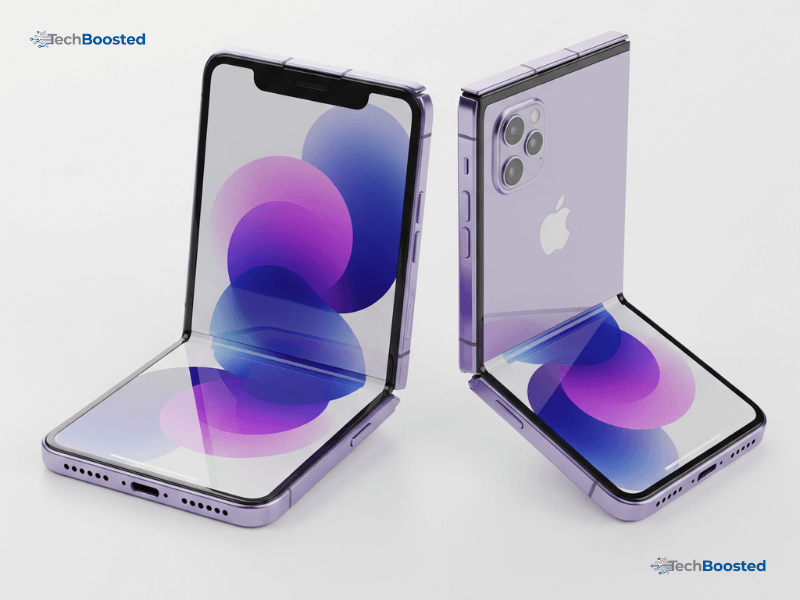
Apple’s foldable iPhone journey started more than 10 years ago. The company filed its first flexible-display patents in 2011 and detailed hinge designs in 2016. Throughout the 2010s, rumors floated between clamshell (Z Flip-style) and book-style (Z Fold-style) designs.
By 2023–2024, real prototypes existed inside Apple. However, the company repeatedly delayed launch. Early foldable panels from Samsung and LG failed Apple’s strict durability tests screens bubbled after a few thousand folds, creases were clearly visible, dust damaged hinges, and under-display cameras looked poor.
Instead of rushing an imperfect product like some Android makers did in 2019–2021, Apple paused the project multiple times. Development restarted only when suppliers met higher standards.
In early 2025, everything changed. Samsung Display finally delivered truly crease-free panels. Foxconn perfected a liquid-metal hinge that survives over 500,000 folds without issues. Ming-Chi Kuo and other analysts confirmed final display specs were locked in.
This perfectionist approach is classic Apple. The company refused to enter the market until the product felt “magical” and problem-free. As a result, the 2026 foldable iPhone will launch as a mature, highly polished device – not another version 1.0 experiment.
Confirmed Release Timeline for the Foldable iPhone
As of late November 2025, credible sources including Ming-Chi Kuo, Mark Gurman, and JP Morgan predict a September 2026 launch for Apple’s first foldable iPhone, aligning with the iPhone 18 Pro models. Mass production is slated to ramp up in the second half of 2026, with Foxconn handling assembly. While some earlier reports floated a potential slip to 2027 due to hinge refinements, recent updates confirm 2026 as the target. This positions the device as a flagship addition to Apple’s lineup, potentially with limited initial availability due to complex manufacturing.
Design and Build Quality: Ultra-Thin Titanium Construction
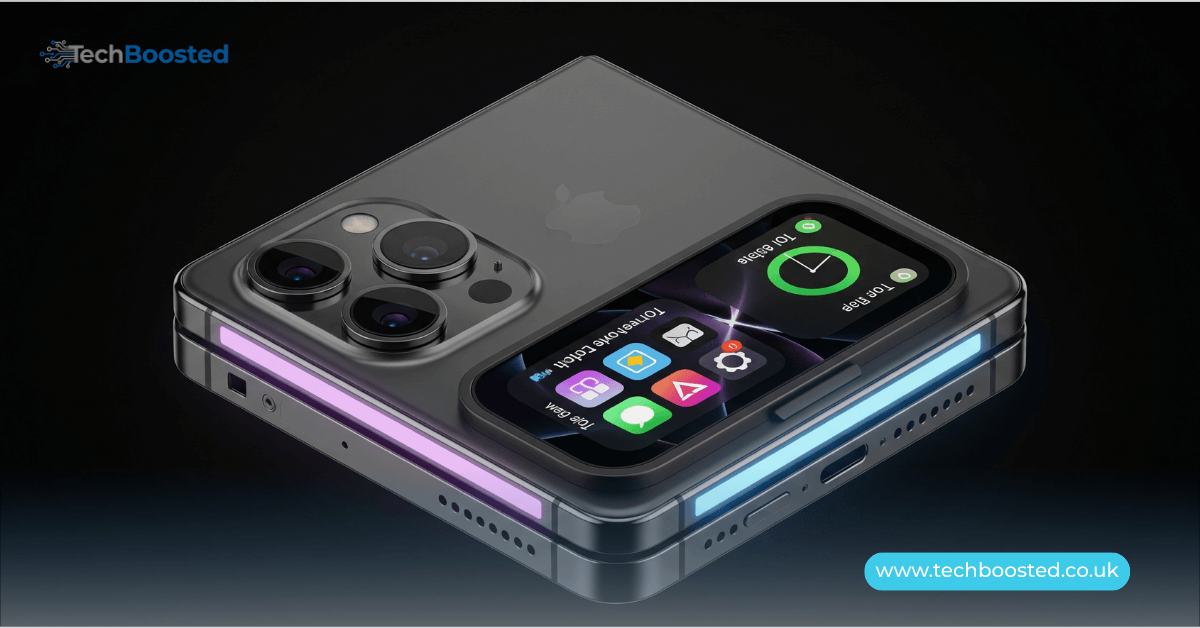
Apple’s foldable iPhone adopts a horizontal book-style fold, unfolding to a tablet-like form while offering a functional outer screen when closed. Bloomberg’s Mark Gurman describes it as resembling “two titanium iPhone Airs joined at the hinge,” achieving an unfolded thickness of just 4.5-4.8mm and 9-9.5mm when folded one of the slimmest profiles in the category. The chassis uses titanium alloy for strength and lightness, paired with a sophisticated hinge incorporating stainless steel, titanium, and liquid metal components for enhanced durability and minimal creasing. Initial color options may include black and white, maintaining Apple’s premium minimalist aesthetic.
Display Technology: Crease-Free OLED Panels
The standout feature is the dual OLED setup: a 7.8-inch inner display with resolutions around 2,713 x 1,920 and a 5.5-inch outer cover screen at approximately 2,088 x 1,422. Apple has prioritized a virtually invisible crease through advanced hinge engineering and potentially Samsung Display’s crease-free technology. Both panels support high refresh rates via ProMotion, delivering sharp, vibrant visuals. The inner screen includes an industry-first 24MP under-display camera, eliminating notches for immersive viewing, while adaptive iOS interfaces optimize content across folded and unfolded states.
Camera and Authentication Innovations
To preserve thinness, the foldable iPhone features a dual rear camera system, likely with a 48MP main sensor and ultrawide lens, rather than the triple setup on Pro models. Front-facing cameras include one on the outer display and a high-resolution under-display option on the inner screen. Biometrics shift to a side-mounted Touch ID sensor in the power button, as confirmed by Kuo and Gurman, to accommodate the folding design and avoid under-display Face ID complexities marking Touch ID’s return to iPhones after years of Face ID exclusivity.
Performance, Battery, and iOS Optimizations
Expected to run on Apple’s latest A-series chip (possibly A20 or beyond) with an advanced neural engine, the device promises top-tier performance for AI and multitasking. Battery life addresses dual-screen demands with high-density cells testing at 5,400-5,800mAh potentially the largest in any iPhone, surpassing the iPhone 17 Pro Max. Efficiency gains from a second-generation C2 modem and optimized display drivers ensure all-day usage. iOS will feature foldable-specific enhancements, including dynamic app resizing, split-screen modes, and seamless continuity between orientations.
Pricing and Market Strategy
Positioned as a halo product, the foldable iPhone is rumored to start at $2,000-$2,500, reflecting premium engineering like custom hinges and advanced displays. This pricing aligns it with high-end foldables from Samsung and targets loyal Apple users seeking innovation, rather than mass-market volume.
Comparison to Samsung, Google, and Other Foldables
Apple’s entry aims to surpass Samsung’s Galaxy Z Fold with a thinner profile, invisible crease, and superior iOS integration. It outperforms Google’s Pixel Fold in camera quality and polish, while offering better durability than options from Honor or Vivo through titanium construction and liquid metal hinges. Where competitors compromise on battery or longevity, Apple’s focus delivers a more refined experience.
Remaining Challenges and Apple’s Perfectionist Approach
Apple delayed its foldable to resolve issues like creases and hinge reliability plaguing early competitors. Ongoing refinements to components like the battery and under-display tech ensure a mature launch, justifying the wait with a device that meets Apple’s high standards.
Conclusion
The foldable iPhone arriving in 2026 represents Apple’s bold step into flexible devices, combining smartphone portability with tablet versatility in a premium, durable package. With innovations addressing key foldable drawbacks and deep iOS integration, it has the potential to redefine mobile productivity and set new industry benchmarks, appealing to users ready for the next evolution in iPhone design.
FAQS
When will the foldable iPhone be released?
The foldable iPhone is expected to launch in September 2026 alongside the iPhone 18 series. Multiple reliable analysts including Ming-Chi Kuo, Mark Gurman, and The Information have converged on fall 2026 as the official timeline, with mass production starting in mid-2026 at Foxconn.
What will the screen sizes be on Apple’s foldable iPhone?
It will feature a large 7.8-inch inner folding OLED display when unfolded (tablet-like experience) and a practical 5.5-inch outer cover display for one-handed use when folded. These sizes make it very similar in unfolded footprint to the Galaxy Z Fold series but with a taller, narrower aspect ratio typical of iPhones.
Will the foldable iPhone have a visible crease like Samsung foldables?
No Apple has reportedly solved the crease problem. Thanks to a new hinge design using liquid metal and titanium components combined with advanced panel technology from Samsung Display, the crease is expected to be virtually invisible, a major advantage over current Galaxy Z Fold and Pixel Fold devices.
How much will the foldable iPhone cost?
Pricing is rumored to start between $2,000 and $2,500 USD, making it Apple’s most expensive iPhone ever. This positions it as a premium “halo” product rather than a mass-market device, similar to how the original iPhone X redefined pricing in 2017.
Will the foldable iPhone have Face ID or switch back to Touch ID?
It will use side-mounted Touch ID embedded in the power button (similar to recent iPad Air and iPad mini models). Apple reportedly decided against under-display Face ID due to technical complexity and thickness constraints in the folding design.
What kind of battery life can we expect from the foldable iPhone?
Despite having two screens, Apple is targeting excellent battery life with a large 5,400–5,800 mAh battery potentially the biggest battery ever put in an iPhone. Combined with highly efficient next-gen silicon and software optimizations, it should comfortably last a full day even with heavy multitasking on the large inner display.
Stay tuned for the latest Apple news and leaks follow us at techboosted.co.uk and check out our in-depth iPhone 17 rumors section for more!