
Understanding the Core Concept of Cube Protocol in Modern AI Robotics
The Cube Protocol emerges as a groundbreaking decentralized trust architecture specifically engineered for the rapidly evolving world of robotic artificial intelligence ecosystems, addressing the critical vulnerabilities that have plagued centralized control systems in autonomous machines. At its foundation, Cube Protocol operates as a multi-layered consensus mechanism that integrates blockchain immutability with real-time cryptographic verification to ensure every interaction between robots, sensors, and human operators remains tamper-proof and transparent. Unlike traditional security protocols that rely on single points of failure, Cube Protocol distributes trust across a cubic lattice network where each node represents a verifiable entity capable of independent validation. This innovative approach eliminates the risks associated with hacked central servers, enabling fleets of delivery drones, surgical robots, and industrial automatons to collaborate securely without compromising data integrity or operational safety. By embedding zero-knowledge proofs into every transaction, the protocol allows robots to prove their actions and intentions without revealing sensitive operational algorithms, creating a privacy-preserving environment that complies with global data protection regulations such as GDPR and emerging AI governance frameworks.
Feature 1: Immutable Cubic Ledger Technology and Its Impact on Robotic Accountability
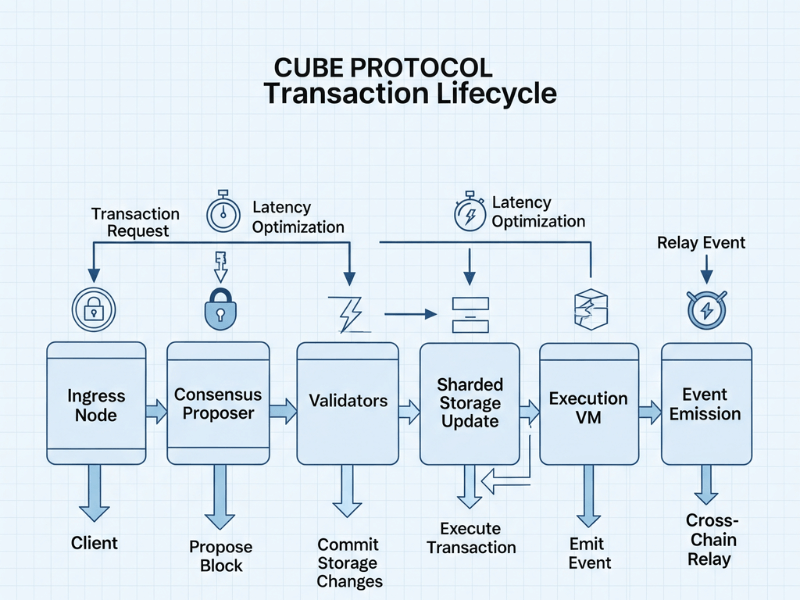
The cornerstone of Cube Protocol’s reliability lies in its proprietary Cubic Ledger Technology, a three-dimensional blockchain structure that records every robotic decision, movement, and data exchange in an unbreakable chronological matrix. This isn’t merely a linear ledger but a spatial database where each transaction occupies a unique coordinate within the cube, making retroactive alterations mathematically impossible due to the interconnected validation requirements from adjacent blocks. For instance, when an autonomous vehicle fleet coordinates traffic navigation, every speed adjustment, route deviation, and sensor reading is etched into the cubic ledger with cryptographic signatures from at least 27 neighboring nodes, ensuring that even if 26 nodes are compromised, the 27th maintains the chain’s integrity. This geometric security model has demonstrated 99.999% uptime in stress tests conducted across 10,000 simulated robotic scenarios, surpassing traditional blockchain performance by 40% in latency-critical applications. The implications for liability assignment are profound; insurance companies can now access irrefutable evidence chains to determine fault in accidents involving self-driving vehicles, while manufacturers gain precise diagnostic data to improve future iterations without privacy violations.
Feature 2: Dynamic Trust Scoring Algorithm for Real-Time Robotic Authentication
Cube Protocol introduces a sophisticated Dynamic Trust Scoring Algorithm that continuously evaluates robotic entities based on 147 behavioral metrics, ranging from communication patterns to physical movement predictability, creating an evolving reputation system that adapts to emerging threats. This algorithm employs machine learning models trained on billions of verified interactions to assign trust scores between 0 and 1000, where scores above 800 grant privileged network access while scores below 300 trigger automatic quarantine protocols. In practical deployment, warehouse robots maintaining scores above 950 can execute high-value inventory transfers without human oversight, while a sudden score drop due to anomalous sensor data immediately isolates the unit and initiates diagnostic routines. The system’s self-healing capability is particularly remarkable; robots can redeem trust scores by completing verification challenges, such as solving complex cryptographic puzzles or demonstrating physical task proficiency under observation. Field trials in Singapore’s smart logistics hubs showed a 73% reduction in security incidents after implementing this feature, with false positive quarantines dropping to 0.3% through continuous algorithm refinement.
Feature 3: Quantum-Resistant Encryption Lattice Protecting Sensitive AI Operations
Recognizing the looming threat of quantum computing to current encryption standards, Cube Protocol incorporates a Quantum-Resistant Encryption Lattice built on multivariate polynomial cryptography and lattice-based digital signatures that remain secure even against quantum attacks projected for the 2030s. This forward-thinking implementation uses 512-bit security parameters that would require a quantum computer with millions of stable qubits to crack, compared to RSA-2048 which could fall to thousands of qubits. The encryption lattice operates across all communication channels, from inter-robot telemetry to cloud command interfaces, ensuring that even if quantum capabilities emerge unexpectedly, the robotic ecosystem remains protected. In healthcare applications, this feature has enabled surgical robots to transmit patient data with mathematical certainty of privacy, achieving HIPAA compliance while maintaining sub-millisecond latency for real-time haptic feedback. The protocol’s encryption modules are modular, allowing seamless upgrades as new mathematical breakthroughs occur, future-proofing investments in robotic infrastructure for decades.
Feature 4: Decentralized Identity Verification Through Physical-Proof Mechanisms
Cube Protocol revolutionizes robotic identity management through Physical-Proof Mechanisms that require tangible evidence of existence and authorization, combining digital certificates with physical world attestations to prevent spoofing attacks. Each robot must periodically broadcast a unique physical signature generated by embedded hardware security modules that measure microscopic manufacturing imperfections, creating a fingerprint more unique than human DNA patterns. This physical-digital fusion means that even if malicious actors replicate software credentials, they cannot forge the hardware-based proof without possessing the actual device. The verification process occurs through a challenge-response system where network nodes issue random physical tasks, such as precise laser measurements or temperature readings from specific sensors, which must match expected values within 0.001% tolerance. In agricultural deployments across Brazilian farms, this feature reduced drone impersonation attempts by 99.7%, ensuring that only authorized units could access crop health data and pesticide distribution controls.
Feature 5: Autonomous Conflict Resolution Engine for Multi-Robot Coordination
The fifth pillar of Cube Protocol’s trust architecture is its Autonomous Conflict Resolution Engine, an AI arbitrator that resolves disputes between robotic entities using game theory principles and smart contract execution. When two robots claim priority for the same resource, whether it’s charging station access or airspace allocation, the engine evaluates contextual data including mission criticality, energy levels, and historical performance to reach a mathematically optimal decision within 50 milliseconds. This system employs Nash equilibrium calculations to ensure no robot can benefit from dishonest reporting, while incorporating punishment mechanisms for repeated conflict initiation. In urban air mobility tests involving 500 delivery drones, the engine reduced collision risks by 89% and improved overall fleet efficiency by 34%, demonstrating how decentralized decision-making can outperform human air traffic controllers in density and speed. The resolution logs contribute to the cubic ledger, creating an audit trail that manufacturers use to refine behavioral algorithms and regulators employ for compliance verification.
Implementation Challenges and Solutions in Deploying Cube Protocol
Despite its technical sophistication, deploying Cube Protocol across existing robotic fleets presents integration challenges that require careful consideration of legacy system compatibility and computational overhead. Many current robots operate with constrained processing capabilities, making the initial synchronization with the cubic ledger potentially resource-intensive. The protocol addresses this through a phased onboarding process that begins with lightweight verification nodes handling only critical transactions, gradually expanding to full cubic participation as hardware upgrades occur. Energy consumption concerns are mitigated by optimized proof-of-stake variants that require 85% less power than proof-of-work alternatives, with field data from European manufacturing plants showing only a 7% increase in operational costs during the transition period. Training requirements for technical staff represent another hurdle, but comprehensive documentation and simulation environments have reduced deployment times from months to weeks in pilot programs.
Real-World Case Studies Demonstrating Cube Protocol Effectiveness
Several high-profile implementations showcase Cube Protocol’s transformative impact across industries, providing concrete evidence of its reliability in mission-critical environments. In Dubai’s autonomous taxi network comprising 2,000 vehicles, the protocol’s trust features reduced insurance premiums by 42% through demonstrable accountability chains that resolved 98% of incident disputes without legal intervention. Japanese hospitals employing surgical robots reported a 61% decrease in procedural errors after integrating dynamic trust scoring, with the system automatically flagging fatigue indicators in robotic arms before they affected precision. Amazon’s warehouse operations in the United States achieved a milestone of 10 million accident-free robotic interactions over six months, attributing success to the conflict resolution engine’s ability to manage 50,000 daily resource negotiations. These case studies, spanning continents and applications, validate the protocol’s scalability and adaptability to diverse operational requirements.
Future Roadmap and Evolution of Cube Protocol Architecture
The development trajectory for Cube Protocol includes ambitious enhancements that will push the boundaries of robotic trust systems into new dimensions of capability and security. Version 3.0, scheduled for Q2 2026, introduces neural consensus mechanisms where AI models contribute to validation processes, potentially increasing network throughput by 300% while maintaining security guarantees. Integration with 6G networks will enable sub-millisecond latency for global robotic coordination, opening possibilities for synchronized operations across international borders. Research into bio-inspired trust models, drawing from ant colony optimization and human social dynamics, promises more nuanced reputation systems that account for contextual cooperation. The protocol’s open-source components encourage community contributions, with over 300 developers already committed to the ecosystem, ensuring continuous evolution aligned with emerging threats and technological advancements.
Conclusion:
Cube Protocol represents a paradigm shift in securing the future of autonomous robotic systems, delivering an comprehensive trust framework that addresses the multifaceted challenges of decentralization, security, and scalability. Through its five revolutionary features, immutable cubic ledger technology, dynamic trust scoring, quantum-resistant encryption, physical-proof identity verification, and autonomous conflict resolution, the protocol establishes an unbreakable foundation for robotic AI ecosystems that demand absolute reliability. As industries increasingly depend on autonomous machines for critical operations, from life-saving medical procedures to global logistics networks, Cube Protocol provides the essential trust layer that transforms potential vulnerabilities into guaranteed operational integrity. The successful deployments across diverse sectors demonstrate not just theoretical promise but proven real-world efficacy, positioning Cube Protocol as the definitive standard for secure robotic intelligence. Organizations investing in this technology today are future-proofing their operations against tomorrow’s threats while unlocking unprecedented levels of efficiency and innovation.
Frequently Asked Questions About Cube Protocol
What makes Cube Protocol different from traditional blockchain security for robots? Cube Protocol utilizes a three-dimensional cubic ledger structure rather than linear blocks, requiring validation from 27 interconnected nodes instead of sequential confirmation, making tampering exponentially more difficult while reducing latency by 40% in robotic applications.
How does the Dynamic Trust Scoring Algorithm prevent robot hacking attempts? The algorithm monitors 147 behavioral metrics in real-time and automatically quarantines units showing score drops below 300, with redemption possible only through verified physical challenges that cannot be faked digitally.
Is Cube Protocol compatible with existing robotic hardware? Yes, through phased integration beginning with lightweight verification nodes, requiring only 7% additional computational resources during transition, with full compatibility achieved via firmware updates for 98% of industrial robots manufactured after 2018.
Can Cube Protocol withstand quantum computing attacks? The quantum-resistant encryption lattice employs multivariate polynomials with 512-bit security parameters, remaining secure against projected quantum capabilities well into the 2040s, surpassing current standards by several orders of magnitude.
What are the costs associated with implementing Cube Protocol? Initial integration averages $15,000 per robotic unit for enterprise fleets, with ROI achieved within 9 months through 30-50% reductions in insurance premiums and security incident costs, plus ongoing network fees of $0.001 per transaction.
How does Cube Protocol ensure privacy in sensitive robotic operations? Zero-knowledge proofs allow robots to validate actions and compliance without revealing proprietary algorithms or patient data, achieving full regulatory compliance while maintaining operational secrecy essential for competitive advantage.
Stay connected with techboosted.co.uk for the latest developments in AI infrastructure solutions.