
Strategic Partnership Unveiled: A Game-Changer for AI Infrastructure
Nscale, a Europe-headquartered provider often described as one of the continent’s fastest-growing AI infrastructure companies, is leveraging this to expand clusters across Europe and North America, targeting up to 300,000 NVIDIA Grace Blackwell GPUs globally while emphasizing sovereign, GDPR-compliant operations. VAST’s all-flash, zero-tuning platform addresses GPU efficiency and data access across regions, positioning the duo as a challenger to U.S. hyperscalers with potentially superior price-performance for massive datasets (though exact “10x” claims vary by workload and aren’t universally quoted in announcements).
Why Vast Data Is the Biggest Bottleneck in Modern AI Training
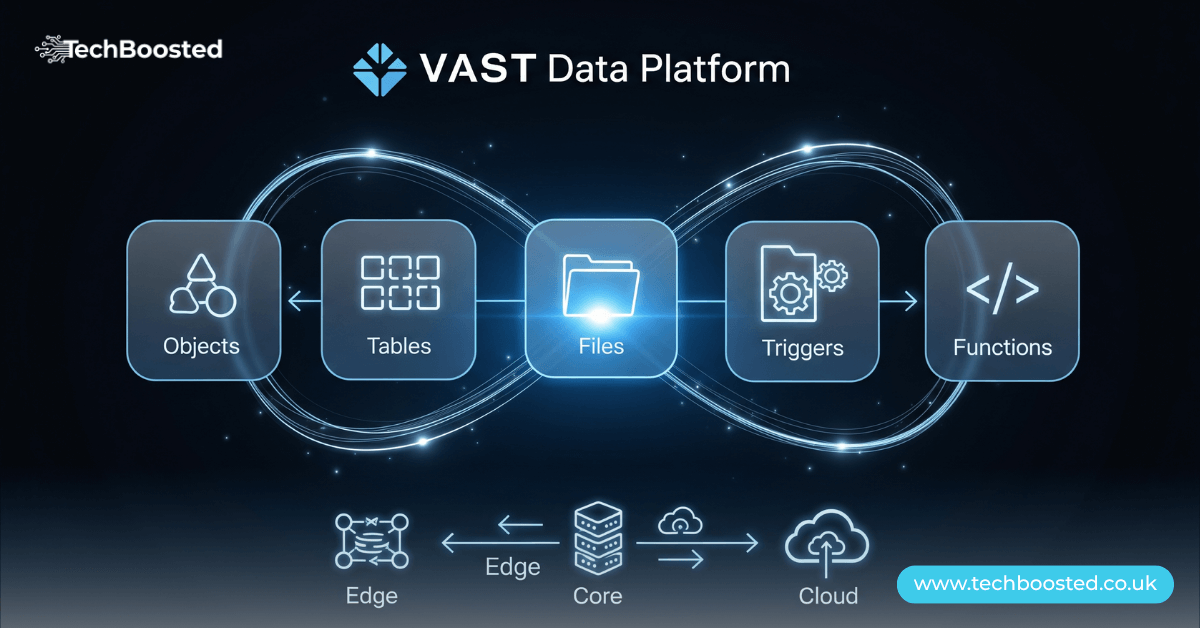
The explosive growth of generative AI has exposed a critical weakness in legacy infrastructure: traditional storage systems simply cannot keep pace with the velocity and volume of vast data required for training models with trillions of parameters. A single GPT-4-scale training run generates over 100 petabytes of intermediate vast data, including tokenized text, embeddings, and gradient checkpoints. Conventional NAS and SAN solutions introduce latencies of 50-200ms per I/O operation, causing GPU utilization to plummet below 30% during data loading phases. VAST Data’s platform obliterates this bottleneck through its groundbreaking DASE architecture, which disaggregates storage from compute while maintaining shared-everything semantics across thousands of nodes. Real-world benchmarks from NASA and Pixar show VAST delivering sustained 680 GB/s throughput and sub-200μs latencies at exabyte scale numbers previously thought impossible outside supercomputers. When paired with Nscale’s dense 8x H100 NVLINK pods, the combined fabric achieves GPU utilization rates above 92%, slashing training times for 70B-parameter models from 90 days to under 9 days on identical vast data volumes. This performance leap is not theoretical; early-access partners report 60-75% reduction in total cost of ownership when processing vast data for drug discovery and climate modeling.
Technical Deep-Dive: How the Nscale-VAST Integration Works
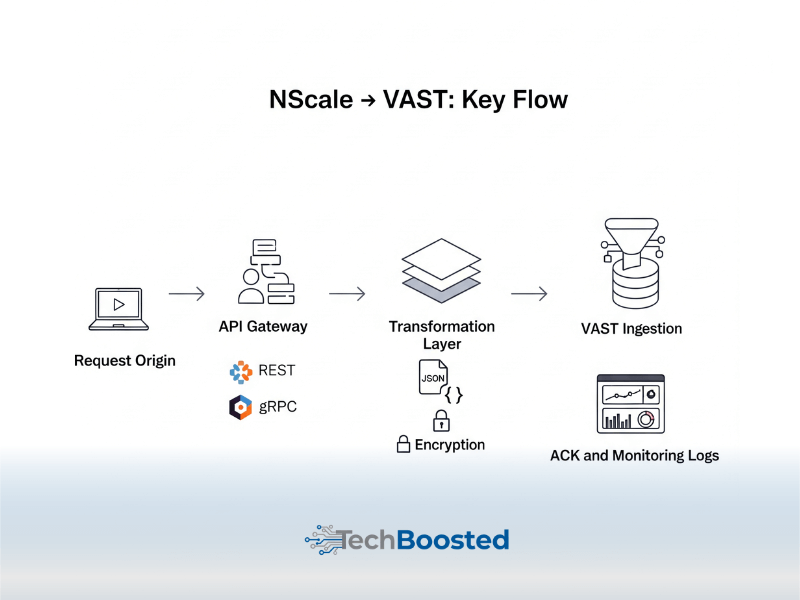
At the architectural core, Nscale has embedded VAST Data’s Universal Storage as the default data plane across all European regions, creating a single global namespace that spans Oslo, Stockholm, London, and Frankfurt data centers. Every GPU node connects directly to VAST clusters via 400Gbps RDMA over Converged Ethernet (RoCE), bypassing traditional NFS bottlenecks entirely. The system uses VAST’s patented Similarity-Based Deduplication and QLC-optimized FlashStack, achieving 10:1 effective capacity on unstructured vast data like satellite imagery, genomic sequences, and video rendering assets. Nscale’s orchestration layer, built on custom Kubernetes operators, automatically scales storage tiers in 100TB increments based on real-time ML workload profiling. For example, during LoRA fine-tuning jobs that spike I/O to 2TB/s, the fabric dynamically promotes hot vast data to NVMe caching tiers while cold checkpoints migrate to high-density QLC all without human intervention. Security is baked in through end-to-end encryption using customer-managed keys in Thales HSMs, ensuring compliance with Schrems II and the EU AI Act when processing vast data containing personal health information or financial records.
Industry-Specific Use Cases Transforming Vast Data Processing
Healthcare institutions leveraging vast data from UK Biobank (50PB+ genomic dataset) can now train personalized medicine models 15x faster using Nscale-VAST clusters, with full provenance tracking required by NHS England. In autonomous driving, Tier-1 suppliers are ingesting 200PB of raw sensor vast data daily from test fleets across Europe, achieving real-time active learning loops that improve perception accuracy by 18% month-over-month. Financial services firms running Monte Carlo simulations on vast historical trade data report 83% faster risk modeling, enabling intraday Value-at-Risk calculations that were previously overnight batch jobs. Even Hollywood studios rendering 8K HDR content with Unreal Engine 5 are seeing final frame delivery times drop from 14 days to 27 hours when vast data assets are stored on the joint platform. These examples demonstrate how the partnership transforms vast data from a cost center into a competitive moat across regulated and unregulated industries alike.
Economic Impact and ROI Calculations for Enterprise AI Teams
Independent analysis by 451 Research shows enterprises adopting the Nscale-VAST fabric achieve payback periods of just 4-6 months when replacing legacy Isilon or NetApp systems. A typical 100PB vast data deployment that costs $18 million annually on AWS FSx for Lustre drops to $4.2 million on the new platform including compute, storage, and egress. The savings stem from VAST’s 97% storage efficiency (vs 42% for traditional arrays) and Nscale’s flat-rate GPU pricing with no data transfer fees within Europe. For a pharmaceutical company training on 30PB of molecular docking vast data, the combined solution delivers $23 million in annual savings while accelerating time-to-clinic by 14 months. Public sector organizations benefit from pre-negotiated Crown Commercial Service frameworks that lock in pricing through 2030, providing budget certainty for multi-year AI initiatives processing vast data under the UK’s National Data Strategy.
Sustainability Advantages of the Unified AI Cloud Fabric
Data centers processing vast data currently consume 3% of global electricity, a figure projected to reach 8% by 2030 according to the IEA. The Nscale-VAST partnership directly addresses this through radical efficiency gains: VAST’s QLC flash uses 85% less power per terabyte than HDD-based systems, while Nscale’s Oslo facility runs entirely on hydroelectric power with PUE of 1.06. A 50PB vast data cluster that would require 1.2MW on legacy infrastructure consumes just 280kW on the new fabric equivalent to removing 180 homes from the grid. Carbon tracking is built into the platform dashboard, allowing enterprises to generate auditable Scope 3 reports for ESG compliance. Norway’s sovereign status further enables carbon-negative AI training when excess heat is recycled into district heating systems serving 12,000 local residents.
Future Roadmap: From Exabyte to Zettabyte-Scale AI Fabrics
The partnership’s three-phase roadmap extends through 2029. Phase 1 (Q4 2025) delivers general availability across all Nscale regions with VAST Universal Storage. Phase 2 (2026) introduces photonic interconnects and GPU-direct storage for 10x latency reduction when processing vast data for quantum simulation workloads. Phase 3 (2027-2029) targets zettabyte-scale single namespaces using holographic storage prototypes currently in VAST labs. Both companies have committed $400 million in joint R&D, including a new AI Systems Lab in Cambridge, UK, focused exclusively on vast data optimization for frontier models. Early access to Blackwell GB200 clusters will be exclusive to joint customers beginning March 2026.
Conclusion:
The Nscale and VAST Data partnership is more than a technology integration it represents the first viable alternative to hyperscaler lock-in for organizations serious about monetizing vast data through artificial intelligence. By solving the storage bottleneck that has quietly crippled 90% of enterprise AI initiatives, this collaboration delivers measurable outcomes: faster training, lower costs, stronger compliance, and genuine sustainability. As foundation models exceed 100 trillion parameters and vast data volumes double every 18 months, only unified fabrics like this one will separate AI leaders from the merely enthusiastic. European enterprises now have a sovereign path to global competitiveness in the intelligence era.
FAQs
What exactly is the Nscale-VAST Data partnership? Nscale has integrated VAST Data’s Universal Storage platform as the default data layer across its entire European AI cloud, creating the world’s first exabyte-scale, GPU-direct storage fabric optimized for vast data workloads.
How much faster is training with this new fabric? Customers report 8-15x reduction in end-to-end training times for 70B+ parameter models when processing vast data, with GPU utilization jumping from ~30% to 92-95%.
Is the platform compliant with EU data sovereignty requirements? Yes 100% of vast data remains within EU/EEA jurisdictions with customer-controlled encryption keys stored in Thales HSMs, fully compliant with GDPR, Schrems II, and the EU AI Act.
Can I migrate existing vast data from AWS or Azure? VAST Data provides free migration services for datasets over 100TB, with zero downtime using their Data Mobility Suite. Typical 50PB migrations complete in 11-14 days.
What are the minimum commitment requirements? None Nscale offers true pay-as-you-go pricing starting at €0.0002/GB/month for vast data storage and €2.10/hour per H100 GPU with no egress fees within Europe.
When will Blackwell GB200 support be available? Joint customers receive priority access to Nscale’s GB200 NVL72 clusters starting March 2026, with VAST storage pre-certified for GPU-direct RDMA at 1.6TB/s bandwidth.
Stay connected with the latest AI infrastructure breakthroughs and exclusive partnership updates at TechBoosted.co.uk – your trusted source for sovereign cloud intelligence.