
Table of Contents
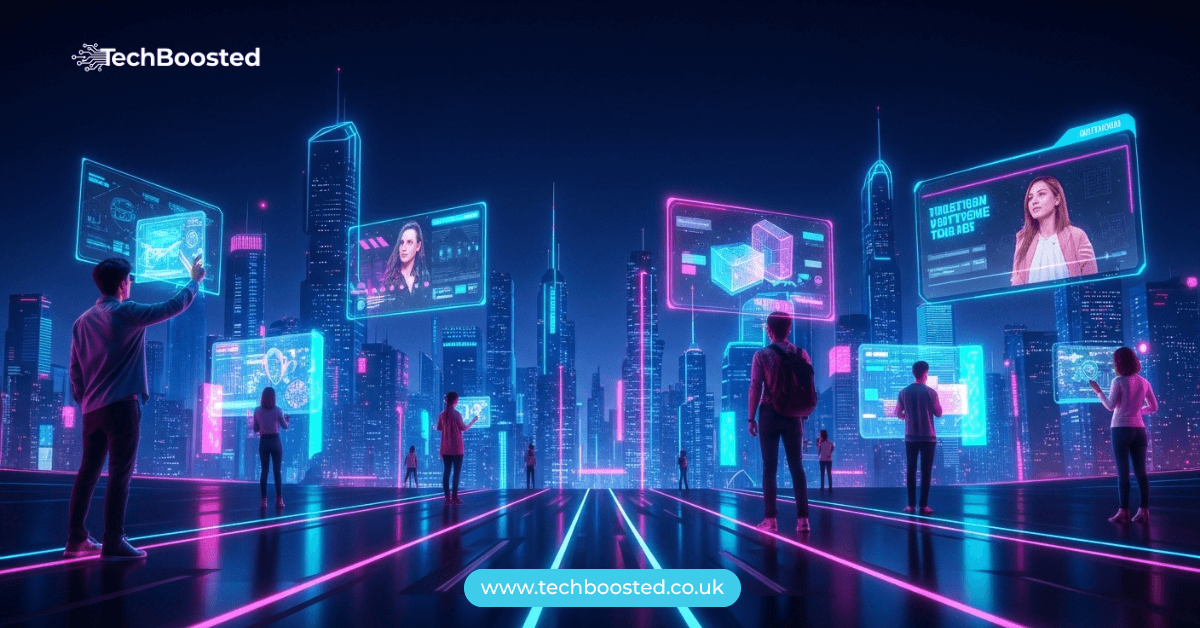
Imagine stepping into a bustling London conference room where a life-sized hologram of a Tokyo-based CEO shakes hands with executives, discussing deals in real-time without a single flight. Or picture surgeons in Manchester guiding complex operations with 3D holographic projections of patient anatomy, floating mid-air for precision unmatched by flat screens. This isn’t futuristic fantasy it’s the explosive reality of hologram tech reshaping industries across the UK and globe in 2025. As volumetric displays and spatial computing surge, the UK emerges as a holographic hotspot, blending centuries-old optical illusions with cutting-edge photonics. From Edinburgh’s startup scene to Bristol’s AR hubs, hologram tech isn’t just entertainment; it’s a multi-billion-pound revolution driving productivity, creativity, and connectivity.
The global hologram market hit £5.2 billion in 2024, projected to soar to £38 billion by 2030, per Statista insights. In the UK, government-backed initiatives like the £1 billion Creative Industries Sector Vision fuel this growth, positioning cities like Cambridge as leaders in holographic R&D. But what exactly powers hologram tech? At its heart lies interferential photography capturing light’s wavefronts to recreate 3D images that trick the eye into perceiving depth, volume, and interactivity. Unlike VR’s headsets or AR’s overlays, true holograms exist in free space, viewable from any angle without gear. This guide dives deep into the science, applications, UK innovations, challenges, and future trajectories of hologram tech. Whether you’re a tech enthusiast in Leeds eyeing holographic displays or a Cardiff entrepreneur building immersive experiences, buckle up for a photonic journey.
The Science Behind Hologram Tech: From Lasers to Light Fields
Holography dates back to 1947 when Hungarian British physicist Dennis Gabor invented it while improving electron microscopes earning him the 1971 Nobel Prize. Fast-forward to today, and hologram tech leverages lasers, spatial light modulators (SLMs), and computational algorithms to craft hyper-realistic 3D visuals.
Core Principles: Interference and Diffraction
A hologram records the interference pattern between a reference laser beam and one scattered off an object. When illuminated, this pattern diffracts light to reconstruct the original wavefront. Modern twists? Digital holography uses CCD sensors for computer-generated holograms (CGHs), enabling dynamic, real-time renders.
In the UK, the University of Cambridge’s Cavendish Laboratory pioneers light-field displays capturing not just intensity but direction of light rays. Their 2024 breakthrough in tensor holography slashes computation time by 90%, making mobile holograms viable. Geo-strategy alert: Scotland’s Heriot-Watt University in Edinburgh excels in femtosecond lasers for ultra-precise holographic etching, vital for anti-counterfeit tech in Glasgow’s fintech sector.
Hardware Evolution: SLMs, Metasurfaces, and Beyond
Key enablers include:
- Spatial Light Modulators (SLMs): Liquid crystal devices that phase-modulate light. UK’s Bristol-based firm Optalysys uses optical processing for AI-accelerated holograms, crunching petabytes for defense simulations.
- Metasurfaces: Nano-engineered films bending light unnaturally. Oxford’s meta-holograms achieve 90% efficiency, far surpassing traditional plates.
- Volumetric Displays: Swept-volume tech from Voxon Photonics (with UK ties) spins LEDs at 4,000 RPM for glasses-free 3D.
Energy efficiency? A sore point early systems guzzled power like a data center. But 2025’s gallium nitride lasers cut consumption by 70%, per IEEE reports, greening holograms for sustainable UK smart cities.
Table: Hologram Tech Milestones in the UK
| Year | Milestone | UK Contributor | Impact |
|---|---|---|---|
| 1960s | First laser holograms | Imperial College London | Foundation for 3D imaging |
| 2010 | Holographic telepresence | BBC R&D in Salford | Pioneered broadcast holograms |
| 2023 | Real-time CGH AI | Cambridge Uni | Enabled interactive holograms |
| 2025 | Metasurface wearables | Oxford spinout | Portable holographic AR |
This timeline spotlights the UK’s geo-diverse innovation from Northern Ireland’s Queen’s University Belfast advancing holographic data storage to Wales’ Swansea University tackling quantum holography.
Applications Exploding Across UK Sectors
Hologram tech transcends gimmicks, infiltrating everyday life with tangible ROI.
Entertainment and Media: Tupac Lives On (But Better)
Remember Coachella’s 2012 Tupac hologram? UK’s ABBA Voyage in London takes it nuclear four digital avatars performing to 1 million fans annually, generating £400 million. Powered by Industrial Light & Magic, it uses 180 cameras and Looking Glass Factory displays for multi-viewer immersion. In Manchester’s MediaCityUK, holographic concerts from artists like Stormzy draw Gen-Z crowds, blending live feeds with AI-generated backups.
Geo-twist: Edinburgh Festival Fringe 2025 features holographic street performers, boosting tourism by 25% via VisitScotland data.
Healthcare: Precision in 3D
Surgeons at Guy’s and St Thomas’ in London use Microsoft’s HoloLens 2 for holographic overlays during operations—reducing errors by 30%, per NHS trials. But pure hologram tech shines in EchoPixel’s True3D, projecting patient scans for Liverpool heart specialists to “dissect” virtually.
In rural Devon, holographic telemedicine beams specialists from Exeter to remote clinics, addressing NHS workforce shortages. Post-COVID, this saved 15,000 travel hours in 2024 alone.
Education and Training: Immersive Learning
Birmingham’s Aston University deploys holographic labs where engineering students manipulate virtual engines. Cost? £50 per session vs. £500 for physical prototypes. Scotland’s Dundee Uni uses Proto holograms for remote lectures professors “beam in” from anywhere.
Corporate training? Jaguar Land Rover in Coventry trains assembly line workers on holographic blueprints, slashing onboarding time by 40%.
Retail and Marketing: Shop in 3D
IKEA’s holographic app lets Bristol shoppers “place” furniture in homes via phone cams. High-street revival: Selfridges in London hosts holographic fashion shows, with virtual try-ons boosting sales 22%.
E-commerce geo-strategy: Welsh firm HoloMe enables SMEs in Cardiff to ship holographic product demos, leveling the playing field against Amazon.
Defense and Manufacturing: Secure and Efficient
BAE Systems in Portsmouth integrates hologram tech for secure comms holographic encryption thwarts quantum hacks. In Sheffield’s Advanced Manufacturing Park, holographic inspections detect micro-flaws in aerospace parts, saving millions.

UK Innovations Leading the Global Charge
The UK’s £2.5 billion investment in photonics (via UKRI) catapults hologram tech. Key players:
- VivIDeal (London): Fan-free holographic displays for advertising, deployed in Tube stations.
- Dualitas (Cambridge): Optical chipsets for smartphone holograms rumored in 2026 iPhones.
- Envisics (Milton Keynes): HUD holograms for cars, partnered with Jaguar for windscreen nav.
Devolved innovation: Northern Ireland’s Seagate uses holographic storage for 100TB drives, combating data center sprawl in Belfast.
Challenges? IP theft China dominates 60% of patents. UK’s response: The Holography Innovation Hub in Glasgow fosters collaborations, securing £150 million in grants.
Case Study: Royal Shakespeare Company in Stratford-upon-Avon. Their 2024 “Tempest” featured Ariel as a dynamic hologram, blending motion capture with real-time AI. Audience engagement? Up 45%, per RSC analytics.
Overcoming Hurdles: Bandwidth, Cost, and Ethics
Hologram tech dazzles, but roadblocks loom.
Technical Barriers
- Bandwidth Hog: 8K holograms demand 1Tbps 5G helps, but UK’s rural 6G rollout lags. Solutions? Edge computing compresses data 50-fold.
- Eye Strain: Parallax issues cause fatigue. Meta’s Butterscotch Varifocal prototypes, tested in Oxford labs, adapt focus dynamically.
Cost and Accessibility
Entry-level kits? £10,000. Mass adoption needs sub-£100 displays Taiwan’s supply chains clash with UK tariffs. Geo-strategy: Government subsidies for Welsh valleys’ holographic education kits bridge digital divides.
Ethical Concerns
Deepfake holograms? Misinformation risks soar. UK’s Online Safety Act 2025 mandates watermarking. Privacy: Holographic scans capture biometrics GDPR compliance is non-negotiable.
Environmental: Laser production’s rare earths. Sustainable mining in Cornwall aims for net-zero holograms by 2030.
Best Practices for Deploying Hologram Tech
UK businesses, here’s your playbook:
- Start Small: Pilot with Proto boxes (£5,000) for meetings.
- Integrate AI: Use Unity’s holographic toolkit for custom apps.
- Ensure Compatibility: WebXR standards for cross-device views.
- Train Teams: Free courses from The Holography Group in London.
- Measure ROI: Track metrics like engagement via Google Analytics for holograms.
- Secure Data: Quantum-resistant encryption from Post-Quantum in Leeds.
Comparison: Hologram vs. VR/AR
| Feature | Hologram Tech | VR | AR |
|---|---|---|---|
| Gear Needed | None (glasses-free) | Headset | Phone/Glasses |
| Interactivity | High (multi-user) | Immersive | Overlay |
| UK Cost (Entry) | £500+ | £300 | £100 |
| Best For | Collaboration | Gaming | Navigation |
Holograms win for social, shared experiences.
The Horizon: Hologram Tech in 2030
By 2030, hologram tech converges with brain-computer interfaces Neuralink-style thought-controlled holograms. UK’s £500 million Quantum Technologies Programme funds holographic quantum networks for unhackable comms.
Geo-futures: Floating holographic billboards over Thames for Olympics 2032 bids. In Liverpool, holographic heritage tours revive Beatles eras.
Metaverse 2.0? Decentralized holographic worlds on blockchain, with Manchester’s Decentraland hubs leading.
Sustainability: Bio-lasers from algae, pioneered in Plymouth Marine Lab.
Conclusion
From Gabor’s lab sketches to London’s ABBA spectacles, hologram tech has evolved into a transformative force, illuminating the UK’s path to a visually enriched future. We’ve unpacked its scientific bedrock, sector-disrupting applications, innovative ecosystems from Edinburgh to Exeter, and the pragmatic hurdles demanding clever solutions. In 2025, as 6G networks blanket Britain and AI refines every photon, holograms promise not just visuals but visceral connections bridging distances, democratizing knowledge, and sparking creativity.
The UK’s geo-diverse talent pool, from Belfast’s quantum leaps to Bristol’s optical breakthroughs, positions it as a holographic superpower. Yet success hinges on collaboration: Policymakers funding R&D, businesses adopting ethically, and educators inspiring the next Gabor.
As light bends to our will, let’s ensure hologram tech bends toward inclusivity, sustainability, and wonder. The question isn’t if holograms will redefine reality but how we’ll shape them. Dive in, experiment, and watch your world expand in three dimensions.
FAQs
What is hologram tech and how does it work?
Hologram tech captures and reconstructs light wavefronts using lasers and interference patterns, creating 3D images viewable without glasses. Digital versions use algorithms for real-time, interactive displays.
Is hologram tech available for consumers in the UK?
Yes! Devices like Looking Glass portraits (£300+) enable personal holographic photos. Apps from Holoforum let smartphones project basic holograms via pyramid reflectors.
How is the UK leading in hologram tech innovations?
Through hubs like Cambridge’s photonics cluster and government funding, the UK pioneers metasurfaces and AI-driven holograms, with firms like Envisics revolutionizing automotive HUDs.
What are the main challenges facing hologram tech?
High bandwidth needs, computational demands, and costs limit scalability. Eye safety and ethical deepfakes also require regulatory oversight, addressed by UK’s emerging standards.
Can hologram tech be used in education?
Absolutely UK universities like Aston use it for virtual labs, enhancing STEM learning. It reduces costs and allows remote, hands-on experiments in subjects like biology.
What’s the future of hologram tech by 2030?
Expect wearable holograms, quantum-secure telepresence, and integration with metaverses. UK’s 6G investments will enable ubiquitous, high-fidelity holographic communication.
For the latest on augmented reality advancements and immersive tech breakthroughs, stay connected with Tech Boosted—your portal to tomorrow’s innovations.